

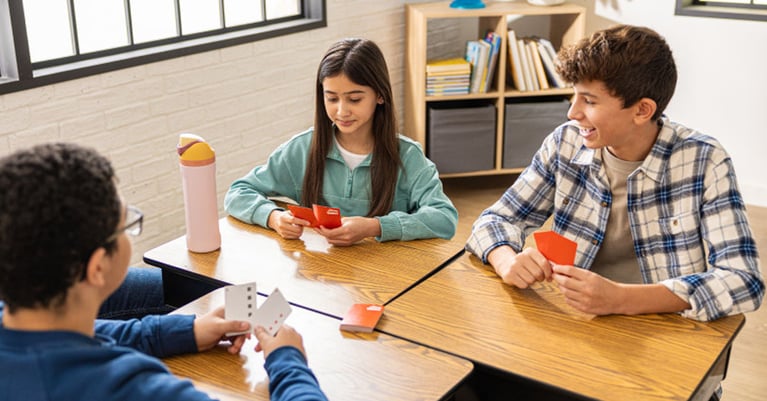
Middle school is a pivotal time in a student’s academic journey—especially in mathematics. It’s often when students begin deciding whether they see themselves as “math people.” The experiences with math that students had and continue to have can shape their confidence, participation, and success in mathematics for years to come.
So how can educators create classrooms where students build a positive math identity and develop a growth mindset?
In our recent webinar, Senior National Curriculum Specialist at Great Minds, Steven Shadel, explored how middle school teachers can foster environments where students feel capable, valued, and empowered as mathematicians.
Why Math Identity Matters
A student’s math identity encompasses their beliefs about math, their abilities, and how they are perceived as math learners.
Math identity is shaped by experiences—both inside and outside the classroom. When students believe their capabilities are not fixed, they are more willing to tackle challenging problems and persist when they encounter difficulty.
Middle school math classrooms are especially powerful spaces for shaping this identity. Unfortunately, it’s not an uncommon experience for students to enter their classrooms with a preconceived notion that they’re not good at math. To improve that mindset, a supportive math environment can help students move from thinking:
“I’m just not good at math”
to
“I can figure this out if I keep trying.”
The Role of Growth Mindset
One of the most important goals for math teachers is helping students see themselves as mathematicians. When students believe they are capable of doing mathematics, they are more likely to stay curious, build mathematical connections, share their ideas, and persist when they encounter challenges.
By creating a growth mindset classroom, teachers can play a crucial role in shaping their students’ mathematical identities.
Teachers can reinforce this growth mindset by:
- Recruiting interest at the start of each lesson
- Affirming students’ mathematical identities through personal relevance
- Developing a growth mindset by providing agency and choice
- Fostering belonging through discourse and collaboration
A growth mindset helps students understand that their learning develops over time. This empowers them to take on challenges, build their confidence, and engage more deeply in problem-solving.
Starting the Day with Meaningful Mathematical Experiences
Students, like all people, are constantly seeking spaces where they feel a sense of belonging, and the math classroom should be one of those spaces. Each student brings their unique way of learning to the classroom. So, when math instruction dives into a problem suggesting that there is only one efficient route, students are missing out on creating meaningful and authentic connections to their learning process.
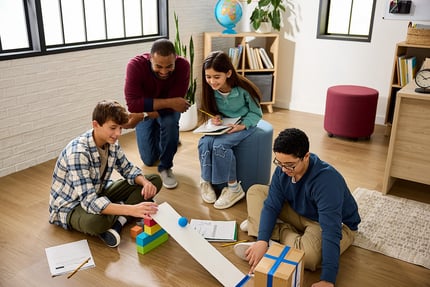 It is important for math instruction to begin with recruiting interest and sparking student curiosity because it encourages students to engage, explore, and connect with math in a way that makes sense to them.
Starting class with student examples, such as examining a correct solution and discussing why it works, what other solution pathways could be taken, and what organized thinking looks like, allows students to engage meaningfully in their learning process.
This approach creates a discourse-rich, collaborative, and engaging classroom environment where students are set up for success and can explore multiple strategies and build deeper understanding.
Creating Opportunities for Mathematical Connections
Another key factor in building math identity is giving students access to rich mathematical tasks. Problems should invite curiosity and reasoning, allowing students to explore patterns, relationships, and multiple approaches–without always trying to find the error.
Low-floor, high-ceiling tasks are particularly powerful in middle school classrooms. These tasks allow every student to begin working on the problem while also offering opportunities for deeper exploration in ways that makes sense to them.
Middle school teachers can leverage these moments and cultivate a classroom culture where:
- Every student has meaningful opportunities to participate in mathematical thinking
- Students share and listen to different strategies
- Mistakes are reframed as opportunities for learning
Creating avenues for success within an inclusive and growth mindset math classroom, enables students to feel valued, confident in sharing their ideas, and empowered to see themselves as capable mathematicians.
Encouraging Collaboration and Discourse
Meaningful student collaboration and discourse is a powerful way to help middle school students build their math identity. When students work with peers to discuss how they might approach a problem, together they can notice the patterns and structure within the problem before solving it.
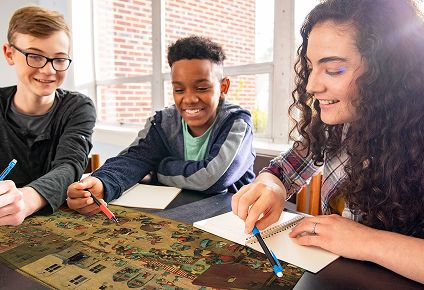
Teachers can support a collaborative environment like this by:
- Asking students to explain their reasoning
- Inviting peers to respond to and build on one another’s ideas
- Encouraging open discussion around different solution strategies
When students hear multiple perspectives and approaches, they begin to understand that mathematics is about thinking, reasoning, and exploring ideas together. As students actively participate in these discussions, they start to recognize themselves as capable mathematicians. Over time, these experiences can transform how students see themselves and their relationship with mathematics.
Ready to Unlock Student Math Identity in your Classroom?
When middle school students begin to see themselves as capable mathematicians, they carry that confidence forward into higher-grade level mathematics, and how they approach challenges and learning in the years ahead.
Additional Resources:
Request a sample of Eureka Math² 

Great Minds
Great Minds PBC is a public benefit corporation. Teachers and content experts write Great Minds curricula, applying their experience to create materials that resonate with students, teachers, and families. Great Minds curricula include Arts & Letters™, Wit & Wisdom™, Eureka Math², PhD Science® and Geodes® books for developing readers.
Topics: math Middle School

Get the Latest Great Minds Updates
Stay informed of simple yet crucial implementation support tips, curriculum updates, new resources, professional development opportunities, and more for math, science, and ELA.
