

Posted in: Aha! Blog > Great Minds Geodes Blog > Geodes > Geodes: Research in Action
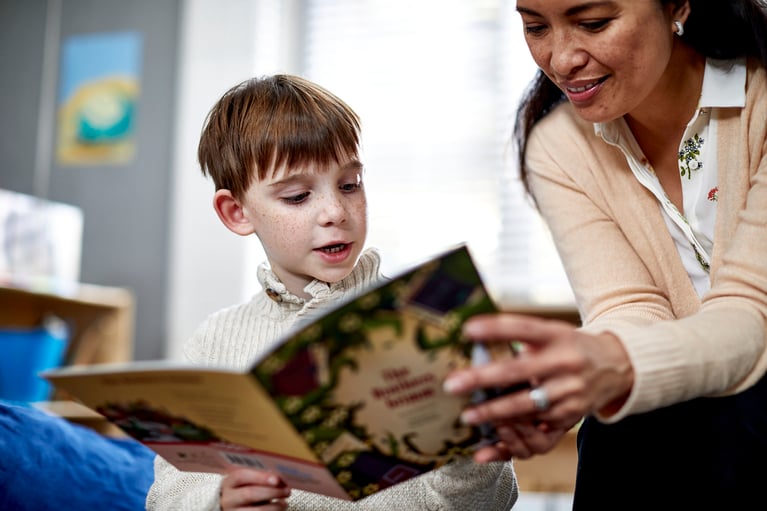
Geodes® decodables are information-rich books that engage students in reading to learn while learning to read. Developed with reading science in mind, the decodables are crafted to ensure students:
- Develop and Apply Literacy Skills
- Build World and Word Knowledge
- Can Read Longer Texts and Make Meaning
- Understand the Content Whether English Language Learners, Kindergarteners, or Upper Elementary Students
Read more about the research behind each, and see how Geodes brings it to life in the classroom.
Take a closer look at Geodes—access our Digital Review Kit.
Developing Literacy Skills
What the Research Says
“Indeed, unconstrained skills such as vocabulary and comprehension develop before, during, and after constrained skills are mastered so there is no evidence to warrant instructional priority of constrained skills over unconstrained skills” (Paris 200).
“Unconstrained skills are particularly important for children’s long-term literacy success (that is, success in outcomes measured after third grade)” (Snow and Matthews 59).
“Even while students are learning to read words, they can and should have opportunities to build knowledge from texts with worthwhile ideas and words. Delaying attention to knowledge building can be especially disadvantageous for students whose academic experiences occur primarily in schools” (Cervetti and Hiebert 501).
What Geodes Does
Geodes provide students with opportunities to practice constrained and unconstrained literacy skills together rather than in isolation. With appropriate teacher support, students learn that reading involves more than simply decoding words. The purpose of reading is also to make meaning and gain understanding. Through reading Geodes, students combine decoding and comprehension skills.
Reading to Learn While Learning to Read
What the Research Says
“Further, the results suggest that when there is a match between method of instruction (i.e., synthetic phonics) and the decodability of words in initial reading texts, a more consistent and successful use of a letter-sound correspondence strategy will result than when there is a mismatch” (Juel and Roper/ Schneider 150–151).
When students read books in which they can apply their phonics knowledge, they can see that “phonics is worth learning and worth using” (Adams 39).
“It is critical that students have the opportunity to practice the phonics patterns they have learned in the context of reading” (Student Achievement Partners 14).
“Evidence suggests that phonics teaching is more effective when children are given immediate opportunities to apply what they have learned to their reading” (Hatcher et al. qtd in Castles et al. 16).
What Geodes Does
Geodes provide students with decoding practice that reinforces students’ phonetic knowledge and gives them an opportunity to transfer their learning while engaged in an authentic reading experience.
Building World Knowledge
What the Research Says
“Comprehension requires both a broad vocabulary and factual knowledge” (Willingham).
“When students have more content knowledge before they read, their understanding is better during reading” (Arya et al. qtd. in Lupo et al. 435).
“Readings and activities should be designed to build on one another and create a coherent body of knowledge” (Liben and Liben 5).
“Our results indicate that content exposure during kindergarten may be an important means for promoting the early achievement of children. We find a consistent and positive effect of exposure to advanced content for all children in both reading and mathematics” (Claessens et al. 424).
“Results revealed that students who read the conceptually coherent texts demonstrated more knowledge of the concepts in their texts, more knowledge of the target words in their texts, and had better recall of the novel text compared to students who read unrelated texts” (Cervetti et al. 761)
“Simply stated, the more readers know about the topics of texts, the better their comprehension and learning from texts …” (Cervetti and Hiebert 499).
“The role of background knowledge has been a well-recognized and researched aspect of reading comprehension for the last four decades. Knowledge plays an integral role in most theories of reading, yet remains an under-addressed aspect of reading instruction for teachers … Although misconceptions may be an inhibitor in comprehension, the presence of rich schemata gives readers a greater opportunity to build a strong understanding of the texts they read” (Smith et al. 21).
“One way to expose students to more complex texts is to organize instruction around topically connected texts. Texts on the same topic are likely to share vocabulary, and the familiarity with terms that students have acquired from simpler texts will enable them to read increasingly challenging texts” (Smith and Hiebert).
What Geodes Does
Each Geodes module focuses on a single topic, such as A World of Books or A Season of Change, with two to four text sets (Kindergarten ranges from 2–4 sets, while Levels 1–2 have four sets per topic) that expand on that topic. This module design helps students build content knowledge as they read. Students use what they have learned to deepen their comprehension of each subsequent book in the set.
Level 3 is also organized into four text sets but only contains 16 books. These books intentionally build skills as well as knowledge and vocabulary about the four topics, setting students up to improve their reading comprehension. Encountering complex ideas and vocabulary in more accessible texts strengthens students’ ability to tackle complex, grade-level texts on the same topic successfully. The Geodes books enrich students’ understanding of a topic, spark curiosity, and develop a rich context and world knowledge that support students’ reading comprehension.
Building Word Knowledge
What the Research Says
“Research quite clearly shows that overemphasizing prediction from context for word recognition can be counterproductive, possibly delaying reading acquisition” (Grossen).
“Predictable reading materials offer a number of advantages. ... Yet these very advantages may not work to facilitate the acquisition of words that can be used to support the readers’ efforts in the nonpredictable materials they will encounter as they grow as readers” (Johnston 253).
“If 70% of word types are nondecodable singletons, with only 20% repeated two to five times, how are first graders expected to bootstrap letter-sound knowledge?” (Hiebert qtd. in Foorman et al. 191)
By learning words that appear frequently in a variety of texts, students are more likely to learn words from context as they read independently (Nagy et al; Cunningham and Stanovich; Baker et al; Beck et al; Moats; Biemiller).
Evidence shows that three word features influence the speed with which words are recognized and learned: meaningfulness, frequency, and grapho-phonemic-morphemic structures (Laxon et al; Leslie and Calhoon; Martinet et al).
“[I]f your students were to read a little of this and a little of that, without rereading anything or dwelling on any topic, then the likelihood of their encountering any given information-bearing word would be quite small. In contrast, if your students read several texts on a single topic, they would encounter a number of domain-specific, information-bearing words. In such texts, the words that rise to the top are those most useful for describing the concepts and relationships that are central to that topic” (Adams 9).
“Knowing a word indeed means knowing as much as possible about it semantically, but also phonologically, morphologically, and orthographically. The greater students’ knowledge in each of these areas, the greater their reading comprehension and the greater their ability to learn new words rapidly and to retain them” (Pearson and Liben).
“Broadly speaking, the number of words known is considered a measure of vocabulary breadth. In contrast, what an individual knows about those words and their semantic associates is considered a measure of depth or quality of knowledge. Research with children to date has found that both breadth and depth of vocabulary knowledge are predictive of reading comprehension ability” (Cain and Oakhill, 2014).
What Geodes Does
Geodes align with students’ phonetic development and are designed to build both decoding skills and content knowledge. The majority of Geodes in Levels K–2 are at least 80 percent decodable, and most of the non-decodable words are intentionally chosen to support key content. Recurring content words (oral in Kindergarten) appear throughout books in each module to bolster students’ background knowledge and ensure that students have multiple opportunities to read these words in context.
Supporting Reading Stamina
What the Research Says
“One important implication for practice is that educators should be alert to the possibility that first-grade students of today might be facing more demands than ever in core reading program exposure. If our findings are borne out in further studies, educators might make a concerted effort to supplement core reading programs with additional texts that provide considerable repetition of word meanings, sight words, and core orthographic patterns (in meaningful contexts)” (Fitzgerald et al. 25).
Students might better anticipate what an unknown word might be if they can read previous words. Furthermore, students might better anticipate a word if they have an understanding of a passage. Their comprehension helps them to anticipate an upcoming word (Wood et al).
What Geodes Does
Geodes are designed to support students’ ongoing development of decoding skills. As possible, nondecodable words are surrounded by clusters of decodable words to ease students’ cognitive load and support decoding.
Sentence length and line breaks support students in building their reading stamina. The average sentence length is increased gradually over the course of the four modules. Similarly, line breaks are strategically constructed to be fluency-friendly.
Supporting Orthographic Mapping
What the Research Says
“As we have discussed, the single most effective pathway to fluent word reading is print experience: Children need to see as many words as possible, as frequently as possible (Stanovich & West, 1989). Teachers can seek to provide as much exposure to print as they can during classroom activities and in homework, but what they can achieve will be minuscule compared with the exposure that children can attain for themselves during their independent reading” (Castles et al. 26).
“According to the self-teaching hypothesis, each successful decoding encounter with an unfamiliar word provides an opportunity to acquire the word-specific orthographic information that is the foundation of skilled word recognition” (Share 155).
“Orthographic mapping occurs when, in the course of reading specific words, readers form connections between written units, either single graphemes or larger spelling patterns, and spoken units, either phonemes, syllables or morphemes. These connections are retained in memory along with meanings and enable readers to recognize the words by sight … With repeated readings that activate orthographic mapping, written words are retained in memory to support reading and spelling” (Ehri 5–7).
What Geodes Does
Geodes books and Warm Up Cards (cards only available at Level 3) offer opportunities for repeated reading practice. Repeated reading contributes to orthographic mapping by providing multiple exposures to words strengthening connections between how the word is spelled and pronounced and what it means.
Geodes Book Notes provide suggestions for how to model fluent reading, scaffold practice, and provide feedback to students.
Supporting English Learners
What the Research Says
“For English speakers and ELLs alike, word learning is enhanced when the words are taught explicitly, embedded in meaningful contexts, and students are provided with ample opportunities for their repetition and use” (Goldenberg 696)
“Research has also provided evidence that background knowledge can play a substantial role in second-language reading comprehension” (Verhoeven 674).
How Geodes Responds
Geodes and the accompanying Geodes Quest™ workbooks (Quest workbooks only available at Level 3) provide opportunities to explicitly teach important vocabulary in meaningful contexts. By incorporating content words that relate to the topics, Geodes books enable multilingual learners to encounter key vocabulary and deepen their knowledge of these words. The engaging topics of Geodes books spark rich discussions and shared experiences that support multilingual learners’ literacy development.
The Quest workbooks (Level 3 only) provide practice opportunities that foster a deep understanding of specific words that are selected to support students’ knowledge of domain-specific vocabulary. Activities in the workbooks reinforce word meanings and examine the phonetic and morphological elements of the words. Together, the Level 3 Geodes and accompanying Geodes Quest workbooks ensure that students broaden and deepen their vocabularies.
Supporting Kindergarteners
What the Research Says
“Young children’s listening and speaking competence is in advance of their reading and writing competence. That is, they can understand much more sophisticated content presented in oral language than they can read independently. As children are developing their reading and writing competence, we need to take advantage of their listening and speaking competencies to enhance their vocabulary development” (Beck, et al. 48).
“Studies indicate that giving children the opportunity to tell stories helps their language development by enhancing vocabulary, syntactic complexity, sense of story structure, and comprehension” (Strickland and Morrow 261).
“Our chances of successfully addressing vocabulary differences in school are greatest in the preschool and primary years” (Biemiller 30).
What Geodes Does in Kindergarten
The first two Geodes modules of Kindergarten each include two Wordless Picture Books, which offer students the opportunity to learn story elements and structures, practice retelling, and boost their oral vocabulary. Geodes in Modules 1 and 2 include an About section, a summary that provides students and teachers with the specific events and vocabulary underlying the text.
In addition, all Geodes books include a More section, a brief informational selection that extends and enhances the content knowledge and vocabulary that correspond with each book. The Geodes teacher resource, Inside Geodes®, includes vocabulary routines and suggested words to introduce. In the Book Notes for Modules 1 and 2, words are selected from the adult-read text within the book. For Modules 3 and 4, vocabulary words are selected from both the child- and adult-read text. Book Notes in Modules 3 and 4 also highlight five oral recurring content words for each module, which students can use to discuss key ideas within and across books. Using the provided vocabulary routine bolsters students’ content knowledge and encourages students to include these words in their book discussions.
Bridging Reading Skills Up to Level 3
What the Research Says
“Results of a longitudinal study of nearly 4,000 students find that those who do not read proficiently by third grade are four times more likely to leave school without a diploma than proficient readers” (Hernandez 4).
“Throughout students’ academic careers, learning to read and reading to learn is the responsibility of all teachers and must occur simultaneously and continually—all day, every day—to adequately prepare students for the demands of college and the workplace. As students move through their educational journey, they develop reading knowledge, skills, and habits, while continuing to build their prior knowledge and expand their vocabulary, which promotes reading proficiency … Leaving the myth of “learning to read and reading to learn” in the past and moving forward with that commitment to continual learning will promote the greatest potential for reading proficiency in the 21st century” (Houck and Ross).
“Ensuring that students receive both accessible and challenging texts depends on attention to text diets—that is, all texts given to students over a school year and across the school years. Texts that support the automatic word recognition that underlies comprehension are especially important in the text diets of beginning and struggling readers who are unlikely to persevere when the challenge is too great. Challenging texts should consume an increasing portion of students’ text diets as their proficiency increases” (Smith and Hiebert).
What Geodes Does in Level 3
By bridging the divide between “learning to read” and “reading to learn,” Geodes books serve a key role for grade 3 students. Geodes also bridge the gap between more highly decodable texts and noncontrolled texts to help students develop the skills they need to proficiently read complex texts.
Level 3 Geodes books help students learn to read by providing continued practice with decoding progressively more complex texts. At the same time, Geodes books help students read to learn by presenting knowledge-rich text sets related to topics such as the sea and outer space. This balance helps grade 3 students consolidate what they have already learned and prepares them for the challenging, complex reading tasks that trade books and textbooks demand.
- Adams, Marilyn Jager. “Decodable Text: Why, When, and How?” Finding the Right Texts: What Works for Beginning and Struggling Readers, edited by Elfrieda H. Hiebert and Misty Sailors, The Guilford Press, 2009, pp. 23–46.
- Arya, Diana J., et al. “The Effects of Syntactic and Lexical Complexity on the Comprehension of Elementary Science Texts.” International Electronic Journal of Elementary Education, vol. 4, no. 1, 2011, pp. 107–125.
- Baker, Scott K., et al. “Vocabulary Acquisition: Curricular and Instructional Implications for Diverse Learners.” Technical Report No. 14, National Center to Improve the Tools of Educators, 1995.
- Beck, Isabel L., et al. Bringing Words to Life: Robust Vocabulary Instruction. The Guilford Press, 2002.
- Biemiller, Andrew. “Vocabulary Development and Instruction: A Prerequisite for School Learning.” Handbook of Early Literacy Research, vol. 2, edited by Susan B. Neuman and David K. Dickinson, The Guilford Press, 2006.
- Cain, Kate, and Jane Oakhill. “Reading Comprehension and Vocabulary: Is Vocabulary More Important for Some Aspects of Comprehension?” L’Année Psychologique, vol. 114, no. 4, 2014, pp. 647–662, doi.org/10.4074/S0003503314004035.
- Castles, Anne, et al. “Ending the Reading Wars.” Psychological Science in the Public Interest, vol. 9, no. 1, 2018, pp. 5–51.
- Cervetti, Gina N., and Elfrieda H. Hiebert. “Knowledge at the Center of English Language Arts Instruction.” The Reading Teacher, vol. 72, no. 4, 2019, pp. 499–507.
- Cervetti, Gina N., et al. “Conceptual Coherence, Comprehension, and Vocabulary Acquisition: A Knowledge Effect?” Reading and Writing: An Interdisciplinary Journal, vol. 29, no. 4, 2016, pp. 761–779.
- Claessens, Amy, et al. “Academic Content, Student Learning, and the Persistence of Preschool Effects.” American Educational Research Journal, vol. 51, no. 2, 2014, pp. 403–434.
- Cunningham, Anne E., and Keith E. Stanovich. “The Impact of Print Exposure on Word Recognition.” Word Recognition in Beginning Literacy, edited by Jamie L. Metsala and Linnea C. Ehri, Routledge, 2011, pp. 235–262.
- Ehri, Linnea C. “Orthographic Mapping in the Acquisition of Sight Word Reading, Spelling Memory, and Vocabulary Learning.” Scientific Studies of Reading, vol. 18, no. 1, 2014, pp. 5–21.
- Fitzgerald, Jill, et al. “Has First-Grade Core Reading Program Text Complexity Changed across Six Decades?” Reading Research Quarterly, vol. 51, no. 1, 2016, pp. 7–28.
- Foorman, Barbara R., et al. “Variability in Text Features in Six Grade 1 Basal Reading Programs.” Scientific Studies of Reading, vol. 8, no. 2, 2004, pp. 167–197.
- Goldenberg, Claude. “Reading Instruction for English Language Learners.” Handbook of Reading Research, vol. 4, edited by M. Kamil et al., Routledge, 2011, pp. 684–710.
- Grossen, Bonita. “30 years of research: What we now know about how children learn to read: A synthesis of research on reading from the National Institute of Child Health and Human Development.” The Center for the Future of Teaching and Learning, 1997.
- Hatcher PJ, Hulme C, Miles JNV, Carroll JM, Hatcher J, Gibbs S, et al. (2006). Efficacy of small group reading intervention for beginning readers with reading-delay: A randomised controlled trial. Journal of Child Psychology and Psychiatry, 47, 820–827.
- Hernandez, Donald J. Double Jeopardy: How Third-Grade Reading Skills and Poverty Influence High School Graduation. The Annie E. Casey Foundation, 2012, assets.aecf.org/m/resourcedoc/AECF-DoubleJeopardy2012-Full.pdf.
- Hiebert, Elfrieda H. “Core Vocabulary and the Challenge of Complex Text.” Quality Reading Instruction in the Age of Common Core Standards, edited by Susan B. Neuman and Linda B. Gambrell, International Reading Association, 2013, pp. 149–161.
- Houck, B. D., and K. Ross. “Dismantling the Myth of Learning to Read and Reading to Learn.” ASCD Express, vol. 7, no. 11, 2012, pp. 1–8.
- Johnston, Francine. “Word Learning in Predictable Text.” Journal of Educational Psychology, vol. 92, no. 2, 2000, pp. 248–255.
- Juel, Connie, and Diane Roper/Schneider. “The Influence of Basal Readers on First Grade Reading.”
- Laxon, Veronica, et al. “The Effects of Familiarity, Orthographic Neighborhood Density, Letter-Length, and Graphemic Complexity on Children’s Reading Accuracy.” British Journal of Psychology, vol. 93, no. 2, 2002.
- Leslie, Lauren, and Anne Calhoon. “Factors Affecting Children’s Reading of Rimes: Reading Ability, Word Frequency, and Rime-Neighborhood Size.” Journal of Educational Psychology, vol. 87, no. 4, 1995, pp. 576–586.
- Liben, David, and Meredith Liben. “‘Both And’ Literacy Instruction K–5: A Proposed Paradigm Shift for the Common Core State Standards ELA Classroom.” Achieve the Core, 9 Sept. 2013, www.achievethecore.org/page/687/both-and-literacy-instruction-k-5-a-proposed-paradigm-shift-for-the-common-core-state-standards-ela-classroom.
- Lupo, Sarah M., et al. “Building Background Knowledge through Reading: Rethinking Text Sets.” Journal of Adolescent and Adult Literacy, vol. 61, no. 4, 2018, pp. 433–444.
- Martinet, Catherine, et al. “Lexical Orthographic Knowledge Develops from the Beginning of Reading Acquisition.” Cognition, vol. 91, no. 2, 2004, pp. B11–B22.
- Moats, Louisa C. “How Spelling Supports Reading: And Why It Is More Regular and Predictable than You May Think.” American Educator, vol. 29, no. 4, 2005–2006, pp. 12–22, 42–43.
- Nagy, William E., et al. “Learning Words from Context.” Reading Research Quarterly, vol. 20, no. 2, 1985, pp. 233–253.
- Paris, Scott G. “Reinterpreting the Development of Reading Skills.” Reading Research Quarterly, vol. 40, no. 2, 2005 pp. 184–202.
- Pearson, P. David, and David Liben. “The Progression of Reading Comprehension.” Achieve the Core, 13 Apr. 2013, achievethecore.org/page/1195/the-progression-of-reading-comprehension.
- Share, D. L. “Phonological Recoding and Self-Teaching: Sine Qua Non of Reading Acquisition.” Cognition, vol. 55, no. 2, 1995, pp. 151–218.
- Smith, Kristin C., and Elfrieda H. Hiebert. “What Does Research Say About the Texts We Use in Elementary School?” Phi Delta Kappan, vol. 103, no. 8, 2022, pp. 8–13.
- Smith, Reid, et al. “The Role of Background Knowledge in Reading Comprehension: A Critical Review.” Reading Psychology, vol. 42, no. 3, 2021, pp. 214–240. doi.org/10.1080/02702711.2021.1888348.
- Snow, Catherine E., and Timothy J. Matthews. “Reading and Language in the Early Grades.” The Future of Children, vol. 26, no. 2, 2016, pp. 57–74.
- Strickland, Dorothy S., and Lesley M. Morrow. “Emerging Readers & Writers: Oral Language Development: Children as Storytellers.” The Reading Teacher, vol. 43, no. 3, 1989, pp. 260–261.
- Student Achievement Partners. “Foundational Skills Guidance Documents: Grades K–2.” Achieve the Core, December 2017, www.achievethecore.org/content/upload/Foundational%20Skills%20Guidance%20Document%20Dec.%202017.pdf.
- Verhoeven, Ludo. “Second Language Reading Acquisition.” Handbook of Reading Research, vol. 4, edited by M. Kamil et al., Routledge, 2011, pp. 661–683.
- Willingham, Daniel T. “How to Get Your Mind to Read.” The New York Times, 25 Nov. 2017, www.nytimes.com/2017/11/25/opinion/sunday/how-to-get-your-mind-to-read.html.
- Wood, Frank B., et al. “On the Functional Neuroanatomy of Fluency or Why Walking Is Just as Important to Reading as Talking Is.” Dyslexia, Fluency, and the Brain, edited by Marianne Wolf, York Press, 2001, pp. 235–244.

Great Minds
Great Minds PBC is a public benefit corporation. Teachers and content experts write Great Minds curricula, applying their experience to create materials that resonate with students, teachers, and families. Great Minds curricula include Arts & Letters™, Wit & Wisdom™, Eureka Math², PhD Science® and Geodes® books for developing readers.
Topics: Geodes

Get the Latest Great Minds Updates
Stay informed of simple yet crucial implementation support tips, curriculum updates, new resources, professional development opportunities, and more for math, science, and ELA.
