

Think of a time in your life when you encountered a challenging task. To find success, you had to learn new skills, stretch your thinking, or even backtrack on some of your efforts. Despite it being a tough task, you overcame it through problem-solving and hard work. This accomplishment gave you the confidence to take on other similar challenges in the future. In other words, your struggle to overcome the task was productive.
This sense of accomplishment and agency, the feeling that one has added tools to their intellectual toolkit, is what teachers strive to instill in their students during math class. However, there is a fine line between struggling productively and just plain struggling.
So where does this fine line exist?
According to the University of San Diego, struggle is productive in a math classroom when the challenge is just beyond what a student can do independently; it occurs in specific, planned activities and not throughout the entire school day; and students can engage their metacognitive skills. Productive struggle is about thinking, not floundering. This struggle is achieved through intentional planning, not through an accidental mismatch of skills and challenge.
When students have the supports to help them struggle productively, they build not only mathematical proficiency but also confidence and independence. By implementing intentional problem-solving tasks, mathematical language routines, and well-chosen scaffolds, teachers can transform every Eureka Math²® California lesson into an experience in which all students, including multilingual learners (MLLs), can persevere, reason, and find their voices in mathematics.
Benefits for Multilingual Learners
When effective supports, such as the ones that will be highlighted in this article, are in place for students to engage with challenging problems, they develop flexible strategies and deeper comprehension, rather than relying on superficial rule-following. They also develop metacognitive skills that empower them to know when and how to ask for help.
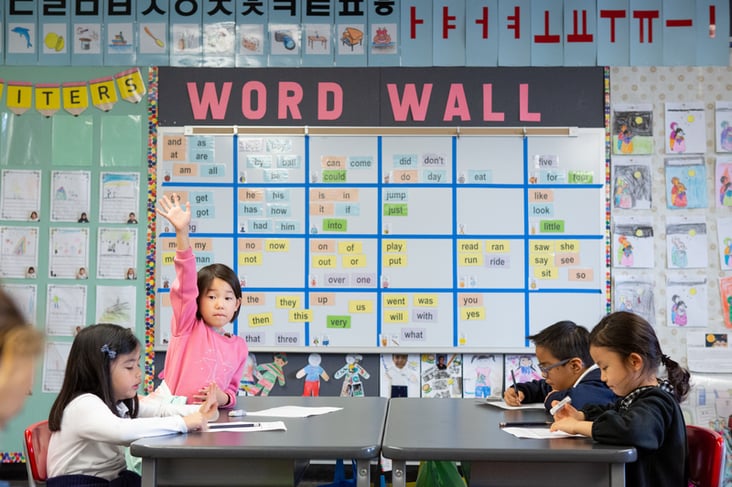
For MLLs, productive struggle also fuels language acquisition. Throughout a task, they have opportunities to use mathematical and academic language authentically through reading, listening, speaking, and writing. When students first encounter a challenging task, they interpret the meanings of mathematical terminology in context to make sense of the problem in the task. As they work, students practice using content-specific vocabulary as they articulate their ideas and stuck points to their peers and teacher. At the conclusion of the task, students communicate their results, revise their explanations, and describe what they have learned.
Design for Discourse and Deep Thinking
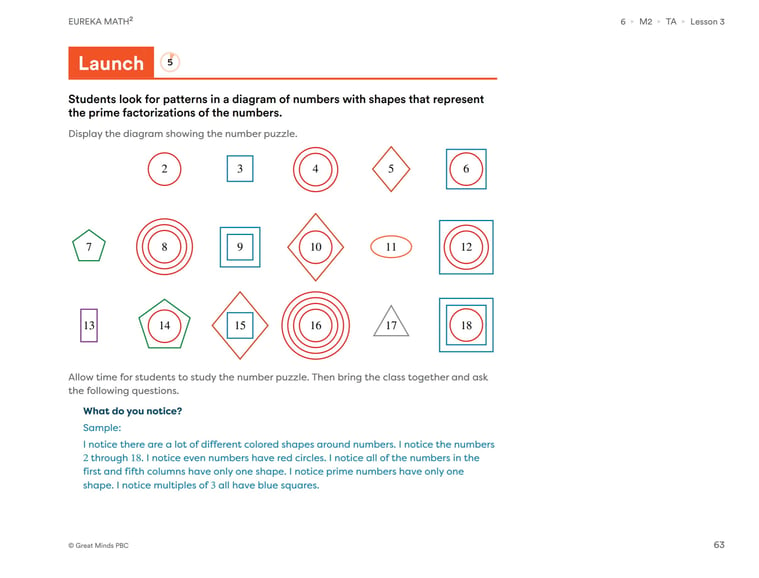
Tasks that encourage productive struggle provide an entry point that is within students’ capabilities. For learning to occur, the task must also allow students to explore and solve problems beyond their current knowledge and skills. This low-floor/high-ceiling structure is a hallmark of Eureka Math² California lessons.
For MLLs, the low-floor entry point means that they can begin working on the task regardless of their English language proficiency. The high-ceiling nature of the task means that MLLs can continue to engage in the task as deeply as is developmentally appropriate for their math and language skills.

For example, in Grade 6, Module 2, Lesson 3, students examine a diagram of numbers with shapes that represent the prime factorizations of the numbers. This task has a low language barrier for MLLs because they can describe the patterns they notice without the need for mathematical terminology. The task also provides organic opportunities for students to learn or utilize content-specific vocabulary such as greatest common factor or prime number.
Eureka Math² California lessons are also structured around student-to-student talk by using math language routines. These routines explicitly cue teachers to elicit multiple solution paths, press for reasoning, and highlight linguistic demands. Directions for routines used in the lessons are provided in each instance in the lesson so that students gradually internalize them and share ownership of their participation in the routine.
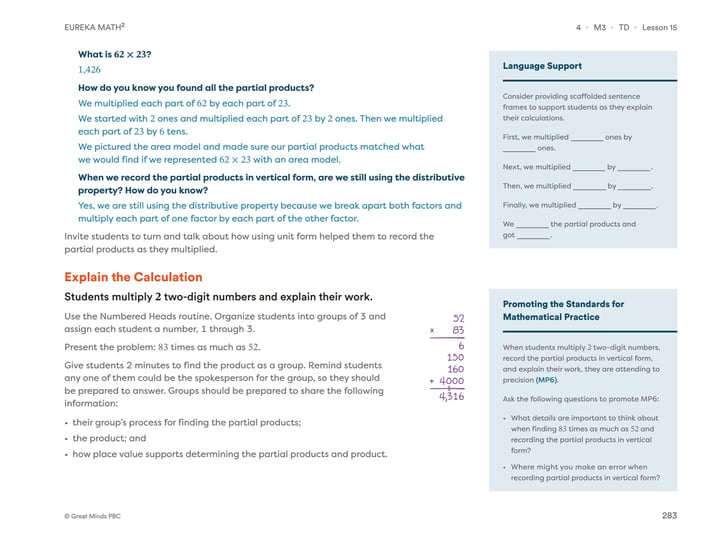
For example, in Grade 4, Module 3, Lesson 15, students engage in the Numbered Heads routine as they multiply 2 two-digit numbers. This routine provides a structure that enables MLLs to know when and how they will engage in class discussion. This allows MLLs to engage in productive struggle with the mathematical content with reduced uncertainty around discourse.
Optimizing for Multilingual Learners
Throughout the school day, MLLs tend to carry a heavier cognitive load than other students. MLLs have to process not only the mathematical content during a lesson but also the language in which it is delivered. When teachers are striving to create opportunities for productive struggle, this heavy cognitive load can become a barrier to learning.
To help alleviate potential intellectual fatigue and overcome barriers to learning, Eureka Math² California employs the following specific task design features. These features can be used to customize any lesson or task to fit students’ academic and cultural backgrounds.
Contextualize and Humanize
Situate tasks in familiar, culturally relevant contexts. Familiarization lowers the cognitive load of language and invites students to use their prior knowledge. Adapting names, foods, or settings gives every student the opportunity to immerse themselves in the math story.
Maintain Cognitive Demand
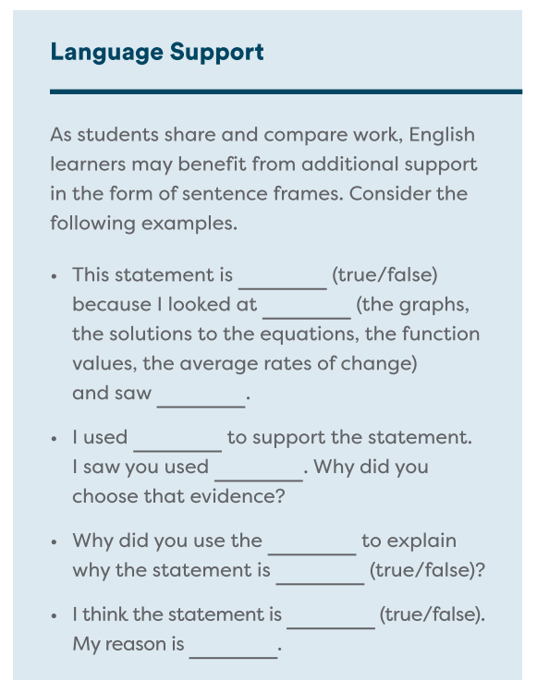
To avoid reducing the mathematical complexity of a task, provide a scaffold so students can access the task. Simplifying mathematical content removes the opportunity for productive struggle and access to grade-level content. Instead of teaching rote procedures, preteach key visuals or terminology. Use sentence frames that allow students to focus on their reasoning, rather than how to express it.
Offer Multimodal Entry Points
Tasks with multiple parts or dense text can overwhelm students. Providing visuals, manipulatives, and gestures before, during, and after reading a problem provides meaning that lowers the cognitive load placed on students. For example, pairing diagrams with concise captions, embedding quick sketches, and enabling easy access to manipulatives lowers the cognitive load.
Allow Strategic Wait Time
Because MLLs are processing both academic content and language, they need additional time to think and formulate responses. They may require even more time if they are simultaneously listening to other students’ responses. You can support MLLs by giving them 30–60 seconds of extra silent think time after presenting a task or posing a question.
Use Purposeful Grouping
Groupings that are heterogeneous in language and mathematical ability expose MLLs to varied English models and mathematical strategies. Further scaffold groups by assigning roles to students within the group. This structure ensures MLLs have the opportunity to take on mathematically rich responsibilities.
Moving Forward
Eureka Math² California already provides fertile ground for MLLs to engage in and benefit from productive struggle such as accessible and rigorous tasks, embedded math language routines, and explicit guidance for teachers. By deliberately layering scaffolds, teachers can empower MLLs to engage in mathematical dialogue, persist through challenge, and own both the language and the ideas of mathematics.

Every voice belongs in the math conversation—even when the problems are tough.
Learn more about how Eureka Math² California was designed to ensure that all students can be fully engaged learners in their classrooms.
