

Why it Matters: Equity and Engagement for MLLs
Recent national assessments have highlighted a significant gap in math and reading proficiency between English learners (ELs) and their peers. For example, in the 2024 NAEP, fourth-grade ELs scored 31% lower in math and 34% lower in reading than their non-EL peers. This highlights the urgent need for targeted support to ensure Multilingual Learners (MLLs) succeed academically.
The Mathematics Framework for California Public Schools addresses this need by emphasizing equitable access to high-quality math instruction that integrates both content and language development. The Mathematic Framework’s goal is not only to engage MLLs in meaningful math learning but also to help them develop academic language skills in ways that are rigorous, relevant, and supportive.

Key Strategies for Supporting MLLs
- Language Development: Focus on academic language through math discussions, vocabulary instruction, and structured language routines.
- Language Scaffolding: Use tools like sentence frames and visual aids to support MLLs at different language proficiency levels.
- Culturally Relevant Content: Connect math instruction to students’ linguistic and cultural backgrounds to make learning more engaging and meaningful.
- Family and Community Engagement: Recognize that learning extends beyond the classroom and involves families and communities in students’ learning.
When teachers embed these strategies into their instruction, they ensure that MLLs not only grasp grade-level math content but also build their language and math skills in tandem. This integrated approach helps prevent language from becoming a barrier to their success.
Integrating Math and Language Learning
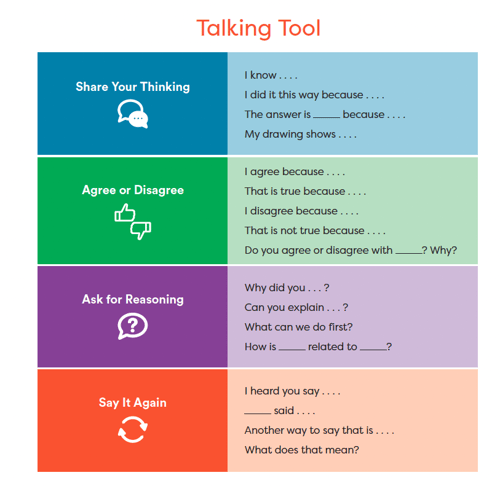 The Mathematics Framework stresses the importance of integrating language development with math instruction. In a truly equitable classroom, math is not just about solving problems—it’s about engaging in discussions where students reason, explain, and justify math ideas using academic language. This helps MLLs develop both math reasoning and academic English, which in turn builds students’ math confidence.
Effective language development in math requires students to practice using the language of math—both verbal and written. Activities that integrate math practices, like reasoning abstractly, constructing arguments, and modeling with math, offer MLLs real-world opportunities to practice language in math contexts, making their learning authentic and contextualized. When math is directly related to their world, students are more likely to connect the language with the concepts being taught.
For example:
- Encourage verbal reasoning: Have students explain their thinking, justify their answers, and evaluate the reasoning of others.
- Use real-world math problems: Contextualize math concepts within familiar situations, helping students make sense of both the math and the language used to describe it.
Supporting Every Learner with Language Routines and Scaffolding
The Mathematics Framework also emphasizes the need for language routines and scaffolding techniques to help students of all language levels succeed in math. These routines are crucial for math understanding and academic language development, both of which are essential for MLLs to thrive in rigorous math environments.
Some key language routines include the following:
- Sentence frames: Help students articulate their thoughts clearly (e.g., “I think this is correct because...”).
- Collaborative learning: Encourage peer discussions that allow students to practice math language in a low-stakes environment.
- Vocabulary development: Focus on essential math terms with visual aids and word walls to reinforce understanding.

Culturally and Linguistically Relevant Content
The Mathematics Framework stresses that math instruction must be culturally and linguistically relevant to engage students fully. High-Quality Instructional Materials (HQIM) should reflect the diverse cultural backgrounds of MLLs, using culturally relevant examples and problem contexts.
These types of problems help students see how math connects to their world and make learning more personal and meaningful. This approach helps bridge the gap between their home languages and cultures and the math content they are learning in class.
Engaging Families and Communities
Family and community engagement in students’ learning is crucial. By involving families through activities like family math nights or encouraging students to share what they’ve learned at home, we can build stronger connections between school and home. These efforts help students see math as relevant beyond the classroom.

Family involvement plays a key role in extending learning beyond the classroom. By encouraging families to engage in math-related activities, we foster a sense of shared ownership of the learning process and provide a supportive environment for students to continue developing their skills.
Why HQIM is Essential
The Mathematics Framework calls for instructional materials that are linguistically accessible, culturally relevant, and that promote both math proficiency and language acquisition. HQIM should provide the necessary supports, such as scaffolding, differentiation, and varied modes of instruction, while maintaining high expectations for math rigor.
By integrating language development with math instruction, these materials should help MLLs develop critical thinking and language skills simultaneously, ensuring they are equipped to succeed in math and beyond. Ultimately, it is this integrated approach that helps build confident math students who are comfortable thinking, speaking, and reasoning in the math classroom and in real-world contexts. This is the kind of environment that sets MLLs up for success and prepares them for the challenges ahead.
