

When Katie McGinn arrived in Park City, Utah, 10 years ago as a sixth-grade language arts teacher, she joined a district where four elementary schools were each doing literacy their own way. Different materials…different expectations…and different philosophies.
“It was a hodgepodge,” McGinn said. “We were addressing standards, but it was teacher-dependent. When kids got to high school, they were great at tasks, but they couldn’t really analyze text in the way we needed them to.”
That fragmented reality became the catalyst for a district-wide commitment to change—one that Superintendent Lyndsay Huntsman, Executive Director of Curriculum Amy Jenkins, and McGinn would pursue together.
After stepping into her role as the district's literacy specialist four years ago, McGinn became a central architect of the plan: a coherent literacy system for K–8. The goal wasn’t just better scores, but rather a coherent literacy system for K–8 that would give every student in every school the same strong foundation and carry them all the way through.
“We knew we wanted coherence across all our elementary schools so that when students went to the next level, that system was still in place,” she said.
Building the Foundation: Wit & Wisdom in K–3
Park City’s first major step was adopting Wit & Wisdom™ for its K–3 classrooms for the 2023–2024 school year. Developed by Great Minds®, Wit & Wisdom is a knowledge-building ELA curriculum grounded in the Science of Reading. Students engage with complex, authentic texts over extended periods of time—reading, discussing, and writing about rich topics that build vocabulary and background knowledge in a sustained, cumulative way.
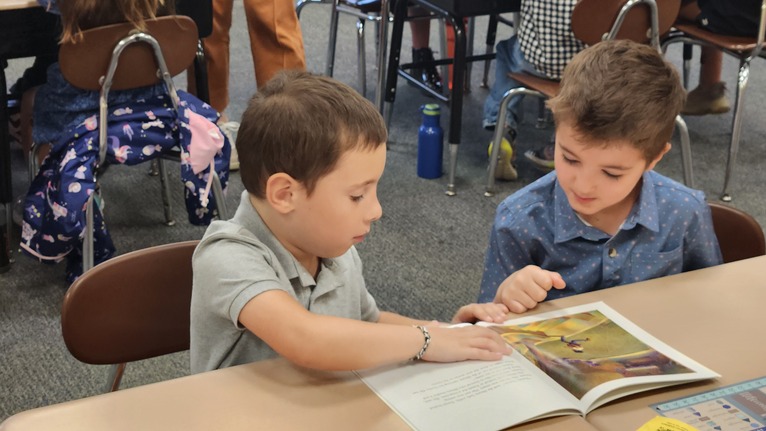
The results in the classroom were immediate. At Trailside Elementary, instructional coach Lori Drivdahl watched first-graders complete a knowledge journal at the end of a unit on Tomás and the Library Lady.
“Every student, including multilingual learners, had something to say,” Drivdahl observed. “They were connecting what they read with their own abilities, and several students mentioned how they could now write about what they’d read. That’s a huge leap for first-graders.”
McGinn saw the same pattern across the district. When teachers used both their foundational skills program and Wit & Wisdom effectively together, students made greater gains—not just in phonics, but in reading, writing, and speaking.
“The phonics piece is important, but if kids aren’t exposed to great texts and reading and writing about them, that foundational work doesn’t have the same weight,” McGinn said. “They have to be working together to build a proficient reader.”
Implementation Support That Meets Districts Where They Are
Transitioning to a new curriculum, especially across an entire K–8 system, is never simple. McGinn credits Great Minds’ implementation support with helping Park City navigate the process with confidence.
The partnership has included summer planning sessions to map coaching schedules, monthly check-ins with the district’s lead Great Minds coach, and collaborative Friday professional development sessions built around real walkthrough data.
“The most important thing I’ve learned is that we are not original in our problems,” McGinn said. “The Great Minds coaches have seen it all. They know what a normal reaction to change looks like, and what’s a true hot spot that needs to be addressed. That perspective is invaluable.”
Great Minds has also provided module studies, lesson studies, and coaching resources that McGinn brings directly to the district’s team of elementary and secondary coaches each month.
Extending the Vision: Arts & Letters Grades 4–8
With K–3 working well, McGinn turned her attention to grades 4–8. For the 2024–2025 school year, Park City adopted Great Minds’ comprehensive K–8 literacy program Arts & Letters™ for grades 4–8. In the 2025–2026 school year, the district completed the transition, switching K–3 to Arts & Letters as well. By next fall, all K–8 students in Park City will be on one coherent system.
Arts & Letters builds on the same knowledge-building foundation as Wit & while integrating feedback from educators who used the earlier program. In grades K–5, it features two coordinated strands: Language Arts, which builds vocabulary and comprehension through authentic whole texts and discussion, and Reading Foundations, which provides explicit, systematic phonics instruction aligned to the same topics and texts. In grades 6–8, the program continues as a knowledge-rich language arts curriculum built around whole books, complex texts, sustained inquiry, and analytical writing.
The driving rationale for the full transition was coherence for students, teachers, and the district as a whole.
“For a struggling reader, having multiple systems wasn’t going to help,” McGinn said. “The coherence mattered for the student experience, such as the structures and routines they know and the consistent vocabulary across the whole day. It was too hard on our developing readers when every school had a different philosophy.”
A Breakthrough for Multilingual Learners
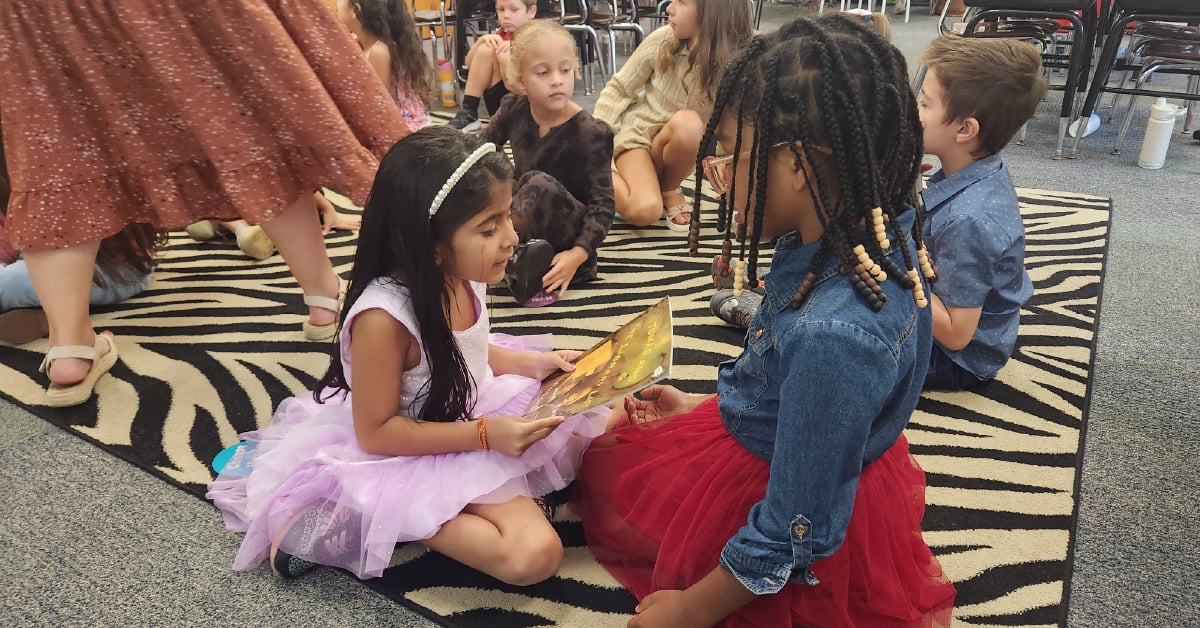 One of the most striking outcomes of the transition has been the impact on multilingual learners (MLLs). The curriculum has a gradual-release structure, building from noticing and wondering, to Think–Pair–Share, to extended writing, giving every student a consistent entry point before the formal task begins.
“The simple-to-complex structure of Arts & Letters gives more opportunity for talking, and that talking shows up in our MLL students’ ability to access the curriculum,” McGinn said. “Our fourth and fifth grade MLLs are accessing the materials and writing longer because of the structure.”
The results have been significant enough that the district is rethinking how it schedules MLL support. Rather than pulling students from Tier 1 instruction, Park City plans to shift to a push-in model during Arts & Letters time to keep those students in the room where the gains are happening.
“It went from ‘they can’t do this, it’s too hard’ to ‘please don’t take them out of my class—they are doing so well,’” McGinn said.
The Role of Whole Books
.jpg?width=1200&height=628&name=A%26L%20Tham%20Luang%20desk%20work%20teacher%20helps%20student%202%20(1).jpg) One of the consistent themes in Park City’s literacy work across both programs has been a commitment to whole books. McGinn credits that choice with building the kind of reading stamina and deep comprehension that excerpts simply cannot replicate.
One of the consistent themes in Park City’s literacy work across both programs has been a commitment to whole books. McGinn credits that choice with building the kind of reading stamina and deep comprehension that excerpts simply cannot replicate.
Her most vivid example: fifth-graders reading All Thirteen, the true story of a Thai soccer team rescued from a flooded cave.
“If that were an excerpt, the kids would have been interested. But the whole book took over,” McGinn said. “All the fifth-grade teachers were texting me: ‘They’re so upset the book ended. They don’t want to leave these characters.’ An excerpt would never have done that. That’s what they’re going to remember from fifth grade.”
That kind of immersion—spending weeks inside a single, well-chosen book—is what McGinn believes builds real readers, not just task-completers.
“Our district is trying to create thinkers and analyzers. Finishing the task is important, but knowing why you did the task is more important,” she said.
Results…and a Goal They Expect to Reach
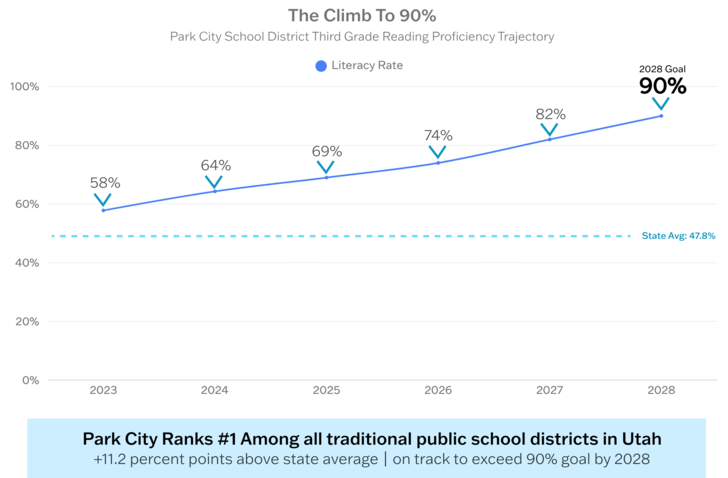
Park City School District has set an ambitious target: 90% of third graders reaching reading proficiency by 2028. Progress is already tracking well above the state average. According to the Utah State Board of Education's Reading on Grade Level report, Park City ranks first among all traditional public school districts in Utah, with 69% of third graders reading at grade level—compared to a statewide average of 48.7%. That number has climbed steadily from 57.8% in 2023 and 64.8% in 2024.
In recognition of that progress, the Utah State Board of Education honored Huntsman, Jenkins, and McGinn with its prestigious District Leader Science of Reading Award in May 2026—recognizing their collective leadership in building an evidence-based, student-centered literacy system.
"I'm more confident than ever," McGinn said. "When teachers are doing both the foundational work and the knowledge-building work together, we see improvement across all our students. We're going to hit 90%."

Great Minds
Great Minds PBC is a public benefit corporation. Teachers and content experts write Great Minds curricula, applying their experience to create materials that resonate with students, teachers, and families. Great Minds curricula include Arts & Letters™, Wit & Wisdom™, Eureka Math², PhD Science® and Geodes® books for developing readers.
Topics: Case Study

Get the Latest Great Minds Updates
Stay informed of simple yet crucial implementation support tips, curriculum updates, new resources, professional development opportunities, and more for math, science, and ELA.
