

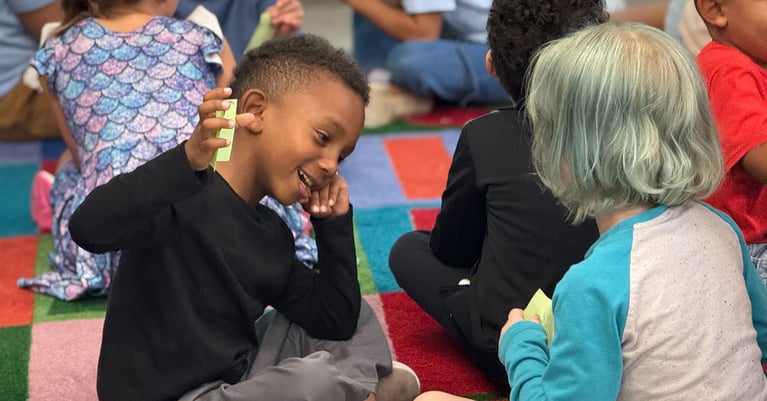
When Eryn Muraoka describes her school’s approach to literacy, she doesn’t start with scores. She starts with a young student holding up a book.
"In third grade, they'll push back on each other in real time," said Muraoka, an instructional coach at Pohakea Elementary in Oahu, Hawaii. "A student will say, 'No, the book doesn't say that,' and then literally hold it up to show you the proof. I’ll tell them: ‘I didn't know you were so argumentative. I love it.’"
That kind of classroom energy didn’t appear overnight. It grew out of a deliberate, structured implementation journey that Pohakea has been building with Great Minds over the past two years, and it reflects a conviction at the heart of the school’s work: that professional learning doesn’t end after the initial training. It has to be ongoing, embedded, and data-driven.
Starting With a Vision, Not Just a Program
Pohakea Elementary is a Title I school serving approximately 485 students. Its population spans a wide range of economic backgrounds and ethnicities, and for years, its literacy results reflected the fragmented approach many schools fall into: disconnected reading and writing programs, inconsistent instruction across grade levels, and no clear throughline of knowledge building, which is vital for reading comprehension.
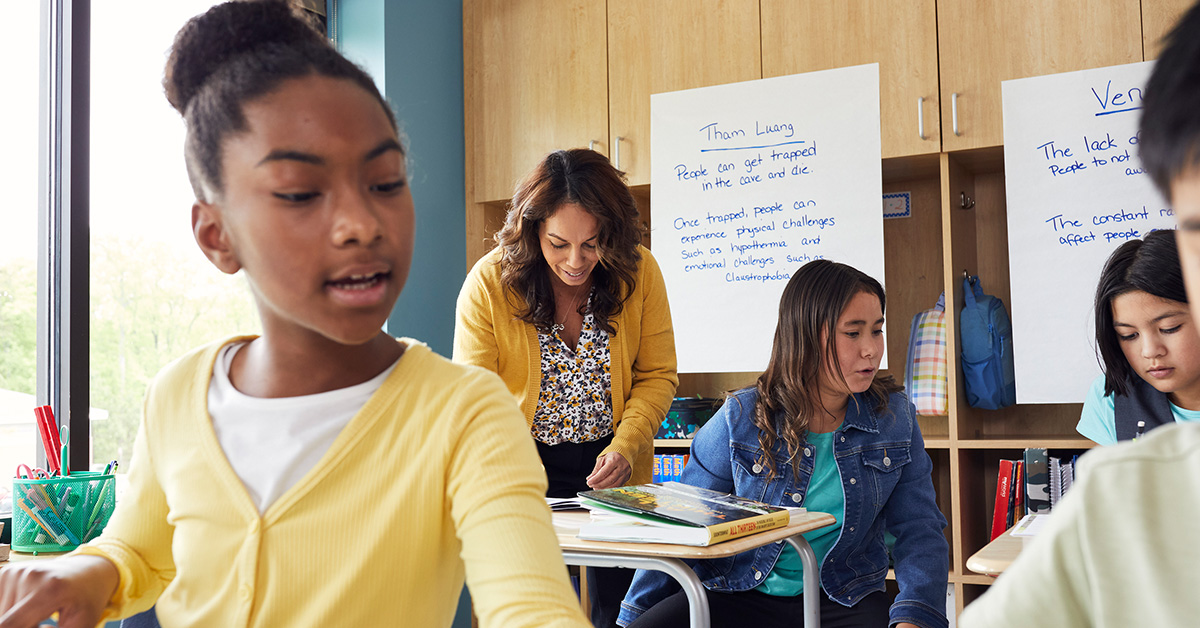 When the school began looking for a new literacy program, the leadership team came in with a clear set of criteria.
“We asked ourselves, what is our vision of what we want a student from Pohakea Elementary to walk away with?” Muraoka said.
They wanted vertical alignment from kindergarten through sixth grade. They wanted authentic whole books in students’ hands. And they wanted reading and writing taught together, not siloed and disconnected, alongside structured opportunities for students to discuss and debate.
She added: “We asked: can this program do it for us? For us, the answer was yes.”
Pohakea piloted Wit & Wisdom™ with first and third grade before transitioning fully to Arts & Letters™, which they are now using in grades 1–3. Next year, the school is expanding Arts & Letters use to K–6.
The Structure That Keeps Implementation on Track
For Muraoka, the most important lesson of the past two years has been that a good curriculum is only as strong as the support structure around it.
“When anybody starts a new program, you typically get professional development (PD). And then what happens after a couple of years? People start veering into their own areas,” she said.
To prevent that drift, Pohakea has built a layered system of support in partnership with Great Minds. It starts with a shared vision-setting process and a formal implementation plan captured in a living Google document that the team revisits throughout the year. That planning document anchors the work and gives everyone a common reference point.
“We can always get better,” added Muraoka. “That’s what keeps us from being complacent.”
Three times a year, the team administers implementation framework surveys that gather perspectives not just from leadership, but from the teachers doing the daily work. The results surface where the school is strong, where it needs support, and how perceptions compare across roles.
“I really like the initial framework surveys and the mid-year follow-up,” Muraoka said. “It helps us identify where our challenges are and where our strengths are, and to get the perception of not just the leadership team, but also of our teachers.”
Walkthroughs That Drive Real Coaching Conversations
Twice a year, in fall and spring, the team conducts 10-minute classroom walkthroughs using criteria drawn directly from the Arts & Letters curriculum. The walkthrough tool focuses on targeted areas including curriculum use, student engagement, and other elements that together paint a clear picture of instructional health in each classroom.
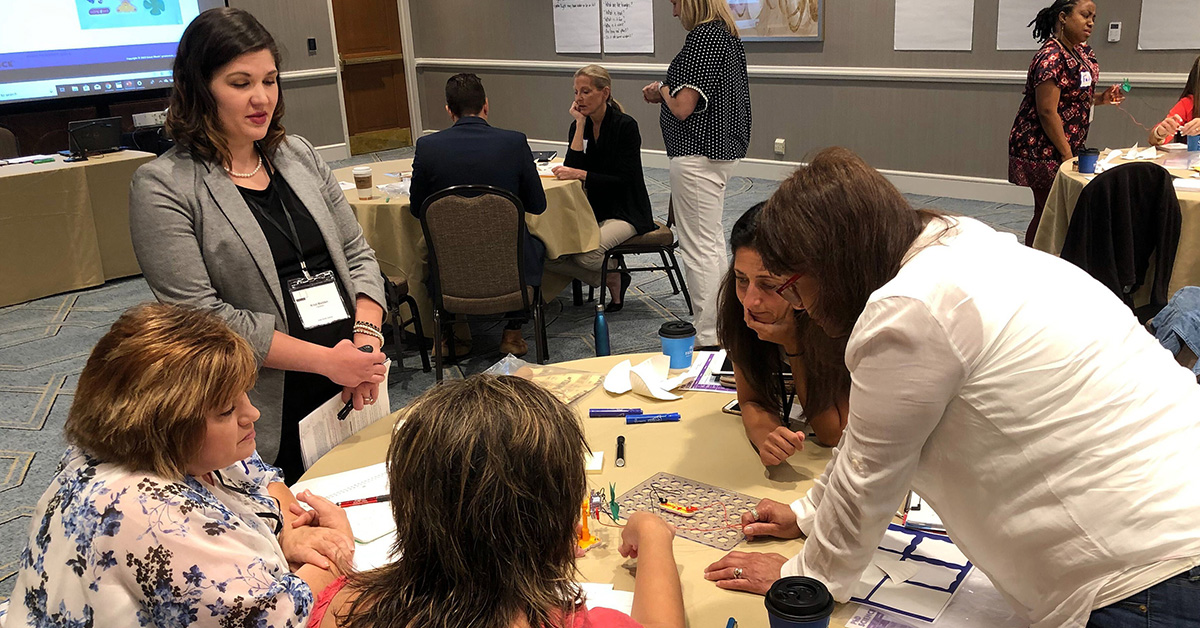 For Principal Traciann Dolim, the structure has made observations more purposeful. “The walkthrough tool is very explicit in what we’re looking for. It’s helpful to look for how to improve, what’s going well, and what we need to work on,” she said.
For Muraoka, the walkthroughs are most powerful when connected to another tool she relies on heavily: the Teaching and Learning Progression guide, or TLP. The TLP maps teacher and student actions across three phases of implementation and makes clear that growth isn’t linear.
“We meet with our Great Minds coach monthly to touch base on our Implementation Success Plan,” Muraoka said. “Once per semester, the Great Minds coach comes to Hawaii in-person for the walkthroughs and model lessons.”
She added: “It helps us to set goals, and then we align what we’re seeing in the walkthroughs with the TLP. “That really helps us identify our school’s focus. Because if we’re focusing on everything, nothing’s a priority. It helps us hone in on what teacher actions we want to focus on first, and then how we’re going to build from there.”
The Partnership That Makes It Stick
Running through all of it is the ongoing relationship with the school’s Great Minds coach, who checks in with the Pohakea team twice a month, leads the walkthroughs, models lessons alongside teachers, and serves as an outside voice who keeps the school focused and honest.
“She’s been really good about supporting us with going into classrooms, planning with teachers before the visit, and then modeling and co-teaching,” Dolim said. “One time she had teachers from the same grade level each take different parts of the lesson and model it, so they could see each other at work. That’s been really helpful.”
“She will push us, even as leaders, to be where we want to be,” Muraoka added. “Having someone from the company remind us of the important components and having a knowledgeable person facilitating and even training us, that’s what keeps us on track.”
The team also participates in professional learning networks, connecting virtually with other school leaders across the country to share experiences, exchange ideas, and solve problems together. Those peer conversations, Muraoka says, reinforce what the coaching makes possible locally.
What Arts & Letters Is Making Possible
While the support structure is the engine of Pohakea’s progress, it’s what’s happening in classrooms that makes the work feel worth it.
Arts & Letters, the literacy curriculum from Great Minds, anchors students in rich whole books and authentic texts over extended arcs of study. Students spend days inside a single book, approaching it through different lenses: first noticing and wondering, then organizing their understanding, then digging into the author’s craft, and finally consolidating the knowledge they’ve built.
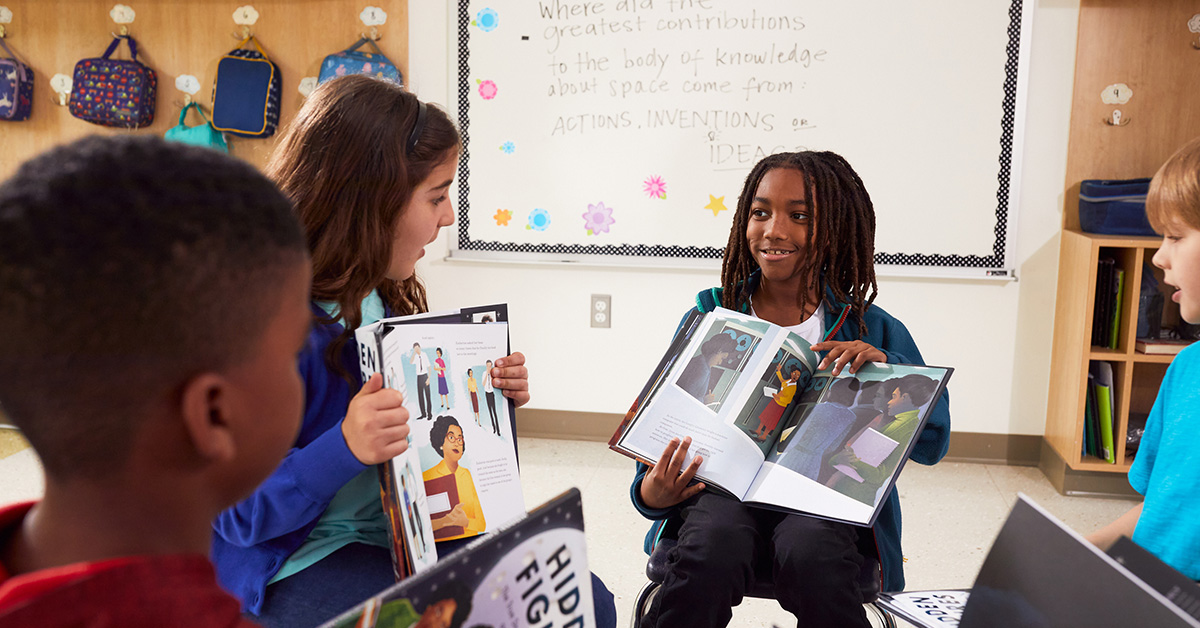 Instructional coach Jamie Miyashiro noted that the knowledge-building approach has made a significant impact on the classroom.
“Building the knowledge gives students confidence, because they know more deeply what they’re talking about,” Miyashiro said. “They feel knowledgeable, and then they’re able to speak and write and do everything regarding what they’ve learned.”
Muraoka has seen it play out in vivid, unexpected moments. A third-grade class studying astronomy began writing about career pathways, debating the difference between an astronomer, a mathematician, and a scientist. A second-grade class on Oahu, an island with no snow, spent weeks absorbed in how snow crystals form, going home to tell their families everything they had learned.
"These are kids who never would have connected a book about space to a career in astronomy. Now they're talking about what those jobs actually look like and how they can see themselves in that future," Muraoka said.
Discourse That Has a Life of Its Own
Before Arts & Letters, Pohakea had been trying to build student discourse into instruction. Leaders gave teachers discussion strategies. They talked about its importance. But without a curriculum that intentionally scaffolded those moments, it rarely took hold.
“You can give teachers discussion strategies, but if it’s not intentionally embedded within the programs they’re using, it’s either going to die, or it’s choppy,” Muraoka said. “Now, with the grade levels that have Arts & Letters, the scaffolding of how to build the discourse has been very intentional.”
Students use sentence stems to agree and disagree respectfully. Socratic seminars give them structured space to push back on each other’s thinking with evidence. And because those routines repeat across modules and grade levels, they become second nature.
The adjustment has required something from teachers too: a willingness to step back. Muraoka describes the shift as moving from being the one on stage to becoming a facilitator of knowledge and inquiry.
“When you see the Socratic seminar and you give just small prompting, the kids can do it. And it’s embedded in multiple modules and different opportunities, so now it becomes a routine instead of a strategy we tried once and hoped would stick,” she said.
Looking Ahead
Next year, Pohakea goes schoolwide with Arts & Letters, bringing fourth, fifth, and sixth grade teachers as well as kindergarten into the fold. With more teachers comes more coaching, more walkthroughs, and more cycles of feedback that have defined implementation so far.
As the program expands to every grade, the scenes that have become familiar in the early grades should spread throughout the building: classrooms alive with debate, students citing evidence without being asked, and readers who don't want the book to end.
For Muraoka, the work ahead is less about adding something new and more about sustaining what is already working. The surveys, walkthroughs, planning documents, and regular check-ins have created a system where complacency is hard to settle into.
“There is always something in the TLP, or through our walkthroughs, or in consultation with our Great Minds consultant that we’re going to find to continuously refine,” she said. “If the teachers can feel and be successful, then we automatically know that the students will be too.”

Great Minds
Great Minds PBC is a public benefit corporation. Teachers and content experts write Great Minds curricula, applying their experience to create materials that resonate with students, teachers, and families. Great Minds curricula include Arts & Letters™, Wit & Wisdom™, Eureka Math², PhD Science® and Geodes® books for developing readers.
Topics: Case Study

Get the Latest Great Minds Updates
Stay informed of simple yet crucial implementation support tips, curriculum updates, new resources, professional development opportunities, and more for math, science, and ELA.
