


How LEARN Charter Network cultivated a community of care, knowledge, and dedication across their network
Ask a leader or coach at LEARN Charter Network what makes their work meaningful, and you'll hear the same thing repeatedly: it's the people. They hold themselves, their teachers, and their students to a high standard.
.png?width=685&height=233&name=Learn%20Charter%20Quote%20(1).png) Research backs this up. A 2024 study tracking over 260,000 Missouri students found that strong eighth-grade test scores were linked to higher rates of college attendance and four-year degree completion (DeChane, Nomi, & Podgursky, 2024). A separate peer-reviewed study found that eighth-grade test scores were one of the best predictors of whether students finished college on time (Cleveland & Scherer, 2025).
Research backs this up. A 2024 study tracking over 260,000 Missouri students found that strong eighth-grade test scores were linked to higher rates of college attendance and four-year degree completion (DeChane, Nomi, & Podgursky, 2024). A separate peer-reviewed study found that eighth-grade test scores were one of the best predictors of whether students finished college on time (Cleveland & Scherer, 2025).
With this goal in mind, LEARN needed a middle school math curriculum that prepares every middle school student for Algebra I in eighth grade. With Eureka Math²®, they found their answer.
Matching the Curriculum to the Mission
Eureka Math² offers Algebra I in eighth grade and accelerated programs for sixth and seventh grade.
The network began its first pilot year in 2023–24 at the LEARN Eight campus. During the pilot phase, they held classroom observations and gathered stakeholder input. In the first year, the Chicago Public School (CPS) Algebra I Exit Exam pass rates jumped from 5% to 43%.
The network made the adoption of Eureka Math2 official for the 2024–2025 school year.
Earning Teacher Buy-in
“Change is difficult, especially if you feel like you've been successful at what you've done.”
—Dana Grzenia, Instructional Coach, LEARN Charter Network
Rather than glossing over the reality of changing curricula, LEARN leaned into it. Many of their middle school teachers had taught with the same curriculum for years, which made trying something new feel like a risk. They knew that implementing a new curriculum was a big ask, and they wanted their teachers to feel prepared for the adoption, confident in their curriculum knowledge, and also proud of their own commitment to shift their teaching practices.
"We spent a lot of time providing presentations and sharing research-based evidence for the effectiveness of the curriculum, and that really got school leaders and teachers excited for it."
—Midm Yi, Instructional Coach, LEARN Charter Network
What Changed in the Classroom
The built-in discourse opportunities, real-world connections, and layered questioning in Eureka Math² pushed teachers to shift their classrooms from being teacher-led to student-centered.
Instructional coach Daniel Junk recalls watching a seventh-grade lesson on applying percents in the real-world context of commission. The teacher started by uncovering what prior knowledge students had, asking, ‘What do you think commission is? How much do you think a car costs in today's economy?’ Then the students got to turn and talk to present their arguments. Then it came to a vote. Then a debate.
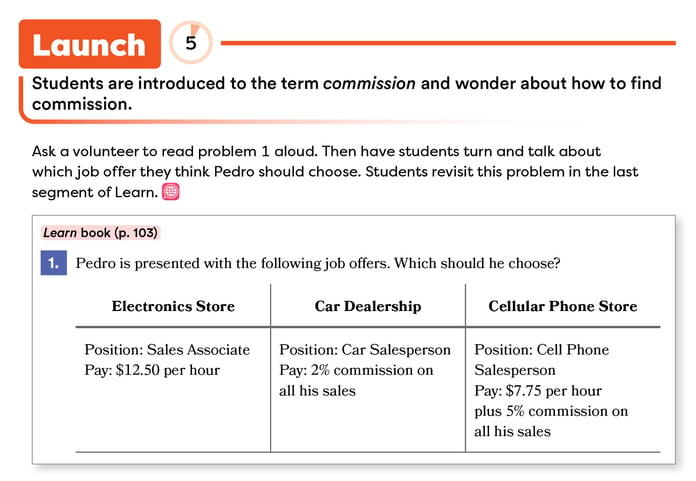
“The kids were so into it, and they were all convinced that their car dealership was the best deal, and they all had valid reasoning. When the materials are mathematically rich, and the prompts are genuinely fun to wrestle with, it’s easier to make teaching fun and engaging.”
—Daniel Junk, Instructional Coach, LEARN Charter Network
This shift showed up across classrooms and grades. Grzenia noted: “We’ve seen an increase in not only student discourse, but in students’ ability to build off of one another’s ideas, question each other, and increase partner practice across the board.”
When students have more opportunities to practice and get comfortable with the knowledge they’re building, they become more confident in math.
Structures That Stick
What LEARN built around the curriculum made the biggest difference.
In the launch year, the coaching team created sessions where teachers across the network could come together to internalize Eureka Math² content and ask questions about the implementation. The team used the Eureka Math² specific walk-through rubrics, so leaders knew exactly what to look for. LEARN partnered with Great Minds Success team members to provide teachers with professional learning that helped them shift from initial launch to making strategic, data-driven adjustments in year two.
"Teachers really have to internalize the content and best practices, where to dig in, where to minimize teacher talk, and where to invest in the big ideas."
—Dana Grzenia, Instructional Coach
The curriculum sets a high bar, but the LEARN team knew that they needed to challenge their students for them to grow. Junk noted, “As a result of learning this curriculum, I am more knowledgeable of middle school math strategies, ideas, how the content builds and aligns. The teacher guide will make you better at math, I promise you that.”
The Results
Since adopting Eureka Math² two years ago, the gains speak for themselves:

These improvements show up across experience levels.
“I have first-year teachers hitting student metric goals. I have veteran teachers who were already rated proficient, doubling their students’ proficiency scores. That tells us about the quality of Eureka Math².”
—Dana Grzenia, Instructional Coach
What Comes Next
LEARN is expanding Eureka Math² to four additional middle school campuses and adding in sixth grades within their K–6 schools. One of these campuses, LEARN DC, in Washington D.C., presents a specific challenge: the geographical distance from the LEARN Chicago schools and the community that supported the original launch.
The coaching team is already preparing. DC teachers are being paired with their Illinois counterparts to fill that gap and become part of the same Professional Learning Communities (PLCs).
“I want the DC teachers to have the same benefits and connections as the other sixth-grade teachers; that professional learning community is really important.”
—Dana Grzenia, Instructional Coach
Walkthrough rubrics and conversations about what to look for on both the teacher and student side are underway so teachers can feel prepared in the fall.
This approach is what made the original adoption work. Don’t just hand teachers a curriculum, build a community of resources around them.
“This is a very human job. Most occupations don’t allow us to build close relationships with our peers, the sense of community, being a part of something, to have that feeling of family, and being a small, but hopefully impactful part of our students’ academic journey.”
—Midm Yi, Instructional Coach

Great Minds
Great Minds PBC is a public benefit corporation. Teachers and content experts write Great Minds curricula, applying their experience to create materials that resonate with students, teachers, and families. Great Minds curricula include Arts & Letters™, Wit & Wisdom™, Eureka Math², PhD Science® and Geodes® books for developing readers.
Topics: Case Study

Get the Latest Great Minds Updates
Stay informed of simple yet crucial implementation support tips, curriculum updates, new resources, professional development opportunities, and more for math, science, and ELA.
