

MA.K12.MTR.1.1 – Actively participate in effortful learning
Eureka Math² Florida cultivates a growth mindset by promoting productive struggle and perseverance. Lessons feature engaging, challenging tasks and collaborative opportunities that build confidence and resilience. Throughout the curriculum, teachers receive robust differentiation supports to meet the needs of all learners. Each task is designed with a low entry point to ensure accessibility for every student, while also offering pathways for enrichment and deeper exploration.
MA.K12.MTR.2.1 – Represent problems in multiple ways
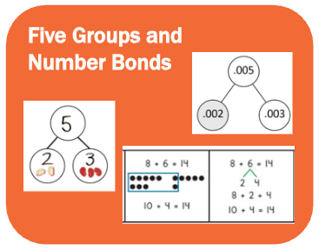 Visual models such as tape diagrams, number bonds, and arrays are integral to Eureka Math² Florida. Students move from concrete to pictorial to abstract representations, strengthening connections between concepts. The writers of Eureka Math² Florida ensured that models, strategies, and vocabulary remain consistent across grades, creating alignment throughout the entire K–5 progression.
MA.K12.MTR.3.1 – Complete tasks with mathematical fluency
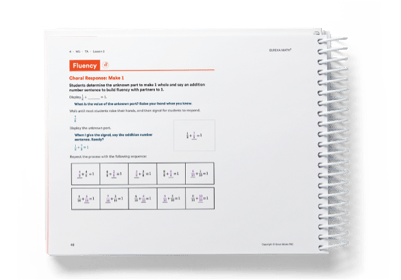 Fluency in arithmetic and automaticity with basic facts are essential for strong mathematical foundations. Florida’s B.E.S.T. Standards emphasize a progression from conceptual understanding to procedural fluency and automaticity. Eureka Math² Florida supports this through structured daily practice grounded in conceptual understanding. Students begin with exploration using manipulatives and visual models, then move to procedural reliability through the concrete representational abstract (CRA) sequence. Eureka Math² incorporates spaced and interleaved practice, immediate application, and discourse-rich routines, ensuring students develop flexible strategies, retain skills, and build confidence for higher-level problem solving.
MA.K12.MTR.4.1 – Engage in discussions about mathematical thinking
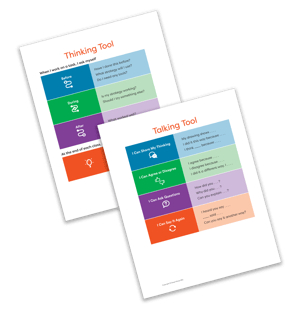 Eureka Math² Florida lessons incorporate structured discourse routines that encourage students to articulate their reasoning and critique ideas, fostering essential metacognitive skills. To support
meaningful discussion and collaboration, the program provides two specialized resources, the Thinking Tool and the Talking Tool, which guide students in engaging productively with peers. Classroom discussion is a cornerstone of the curriculum, intentionally woven throughout every module to deepen understanding and promote a culture of shared learning.
MA.K12.MTR.5.1 – Use patterns and structure to help understand and connect mathematical concepts
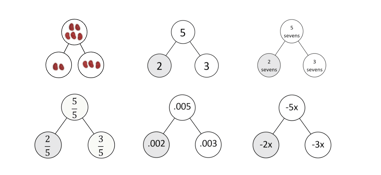 Eureka Math² Florida aligns with this standard through its coherent design and structured approach. Lessons consistently build on prior knowledge, using visual models and strategies that highlight patterns and relationships. The curriculum’s Concrete-Representational-Abstract (CRA) progression helps students recognize structure and apply it flexibly. By vertically aligning models, strategies, and vocabulary throughout the curriculum, Eureka Math² Florida ensures students develop the ability to generalize, plan, and solve problems with confidence.
