

Teaching Math as a Coherent Story
When students begin their mathematics journey with Eureka Math² Florida, what they are learning is carefully framed so that they build understanding through the concrete-representational-abstract (CRA) progression: first working with hands-on models, then pictorial representations, and finally abstract notation. Rather than presenting an equation as an isolated abstract symbol to decode, students are guided to see that equation as the final chapter of a story they already lived through concretely and pictorially. This pathway makes math learning sticky.
As students progress through elementary school under a curriculum that doesn't follow an intentional math story, learning too often becomes a series of disconnected lessons, causing students to lose ground on critical learning gains made in the earliest years of instruction. Fortunately, Florida's B.E.S.T. Standards — brought to life through the Formula for Success — are designed to help students see math as a continuous and interconnected story, from kindergarten through grade 5 and beyond, allowing the storytelling from the earliest years to meaningfully land and compound year after year.
A Shift in How We Think About Math Teaching
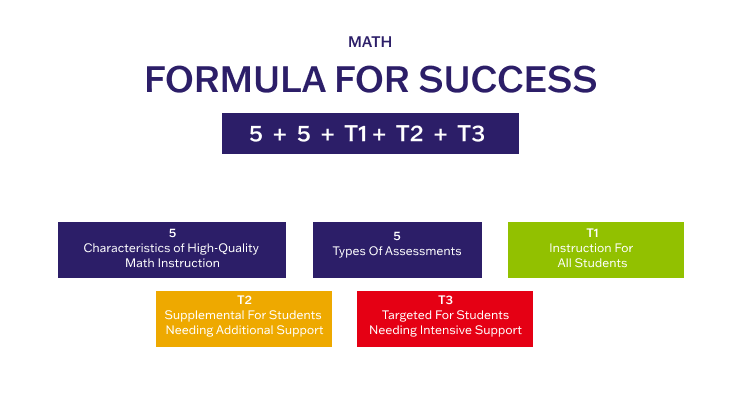
Florida's Formula for Success represents a shift in thinking in how educators and curriculum publishers should approach math teaching. In the past, teaching was often organized purely around covering individual standards one at a time. A curriculum would typically align to both major and minor benchmarks throughout the year, with the emphasis on coverage rather than on how the learning takes shape from a student's perspective. As a result, students often perceived math instruction as a series of fragmented procedures to solve problems algorithmically, rather than understanding how their current learning built on previous understanding and prepared them for future learning.
Florida's Formula for Success provides a vision for five essential Characteristics of High-Quality Math Instruction, paired with a multi-tiered system of support system (T1, T2, T3) — to ensure that all students have a chance to demonstrate success. It asks: is instruction horizontally and vertically aligned? Is it balanced, student-centered, informed by data, and structured to reach every learner through tiered support? These characteristics don't just describe good teaching in isolation, they describe a coherent system, one where each year's learning is deliberately built to connect to the next and every learner is actively engaged in grade level learning alongside their peers.
Eureka Math² Florida brings this tiered structure to life with two purpose-built tools. Eureka Math² Equip® is a diagnostic assessment system that first identifies the strengths that each student brings and then pinpoints unfinished learning before a module even begins, giving teachers a clear picture of student readiness without adding instructional days. Math Catalyst™ provides targeted Tier 2 and Tier 3 instructional resources for teachers — on-level practice, focused intervention, and extension — needed to close those gaps, all while staying fully aligned to Tier 1 instruction so students never lose the thread back to grade-level learning. (see the Math CatalystTM scope & sequence, here)
Coherence Makes Learning Sticky
Research tells us that new knowledge sticks best to existing knowledge. When students can build on a developing, integrated body of knowledge, learning is simpler, less susceptible to errors, and less likely to be forgotten.
Florida's Formula for Success takes this idea that knowledge is sticky and puts coherence at the center of math instruction. By requiring horizontal alignment (consistent models and strategies across a single grade level) and vertical alignment (a clear, connected progression from one grade to the next), the Formula for Success ensures that content is organized around the coherent flow of math — not just the order of the benchmarks. True high-quality math instruction sequences learning so students see the connections from one piece of learning to the next, creating a schema that supports deep conceptual understanding.
Coherence, Built Right Into the Page
In Eureka Math² Florida, this coherence isn't left to chance, it's built directly into the pages teachers use every day. In the Teach book (teacher edition), every lesson opens with a Lesson at a Glance that frames what students should know, understand, and do before instruction even begins. Topic Overviews summarize how that learning connects to what came before and what's ahead, so teachers always know where a lesson sits in the bigger progression. Key Questions spotlight the coherence and connections a lesson is building toward, and Achievement Descriptors define exactly what students should be able to do by the end.
Teachers are given a clear, in-the-moment view of where students are starting from, what they're working toward, and how to tell when they've gotten there.
What Horizontal and Vertical Alignment Look Like in Practice
Horizontal alignment means that within a single grade, concepts, models, and strategies reinforce one another rather than living in separate silos. Vertical alignment means that what students learn in one grade sets them up for what comes next — so a third grader building an understanding of fractions as relationships is laying the groundwork for the visual fraction models they'll encounter in grade 4, which in turn prepares them to see division in a new way in grade 5.
You can see how this kind of learning builds over time: at each grade level, students add a layer of understanding to what they already know, arriving at a more complete picture rather than starting over with an isolated new topic.
While the benchmarks themselves advance in complexity by grade level, the underlying instructional characteristics — balanced instruction, student-centered learning, tiered support, data-informed teaching — stay consistent from kindergarten through grade 5. This continuity is what gives Florida classrooms a coherent throughline, adding to the stickiness of the new knowledge students build each year.
The Bottom Line
With horizontal and vertical alignment threading together a coherent progression of learning from year to year, students can truly begin to see math as a story. Over time, they make connections from previous learning to new learning, building a deep and lasting conceptual understanding of math. That means that by the time students arrive at a topic like division, they'll have the background knowledge from their fractions learning to see that division isn't a discrete math concept, but that there's a logical learning progression from fractions to division.
By developing this conceptual understanding, students move beyond memorizing complicated procedures for math and are able to solve complex problems because they understand the why behind the math, not just the how. That's the Formula for Success at work.
