EM2_FL_logo_R_primary_F26A36_web

Delivering Florida's Vision for Math Instruction with Eureka Math2 Florida

Article 2_image1_hero

The Florida B.E.S.T. math standards and Florida’s Formula for Success are clear: high-quality mathematics instruction must reflect a balanced set of instructional approaches to ensure every student succeeds. The real challenge for districts isn’t understanding what these approaches are. It’s finding a curriculum that truly operationalizes them in daily instruction, not just in philosophy or isolated lessons.

Eureka Math² Florida was designed to meet that challenge. It is not a generic program adapted for Florida, it is purpose-built to deliver the state’s vision, with systematic instruction as the backbone - intentionally layered within every lesson, module, and grade-level progression.

Eureka Math² Florida is also purposefully designed to align with Florida’s Formula for Success. Its structured design, coherent progressions, and research-based practices ensure that every lesson moves learning forward and supports lasting understanding. Florida’s Formula for Success identifies the following key characteristics that should be present in effective math classrooms:

  • Builds on prior knowledge and prepares students for what comes next

  • Is carefully planned with clear goals, routines, and purposeful use of materials

  • Strengthens students’ use of academic and mathematical language

  • Leads to deeper understanding, stronger engagement, and improved outcomes

These expectations point to the need for instruction that is balanced and intentionally structured. Eureka Math² Florida provides a systematic approach to bring these important characteristics to life.

Fluency-Launch-Learn-Land_graphic


Systematic Instruction: The Backbone of Coherent Learning

At the core of Eureka Math² Florida is a highly structured, carefully sequenced progression of learning. Concepts are introduced, revisited, and extended in a way that moves students from simple to complex - within lessons, across modules, and throughout grade bands. This instructional model reflects Florida’s Formula for Success guidance. Florida’s Formula for Success describes high-quality instruction as intentionally planned learning that builds on prior knowledge, develops future understanding, and uses clear academic language to deepen student thinking. This approach results in greater engagement, stronger conceptual understanding, and improved outcomes.

In Eureka Math² Florida students encounter familiar models and structures year after year, increasing in sophistication rather than starting over. For example, number bonds used in early grades evolve into representations of multiplication, fractions, and algebraic expressions in later grades. Rather than reteaching new approaches each year, students build on the models, strategies, and vocabulary they already know.

This coherence is made possible through a deliberate lesson design that shapes how students experience mathematics every day. Each lesson follows a predictable structure, launch, learn, and land, that supports engagement while maintaining the systematic progression across grades.

The launch phase recruits student interest and activates prior knowledge. Students are invited into the mathematics through visual prompts, images, or short experiences that build context and reduce barriers to entry. These moments are intentionally designed to ensure all students have the necessary background and contextual knowledge to access the learning from the start.

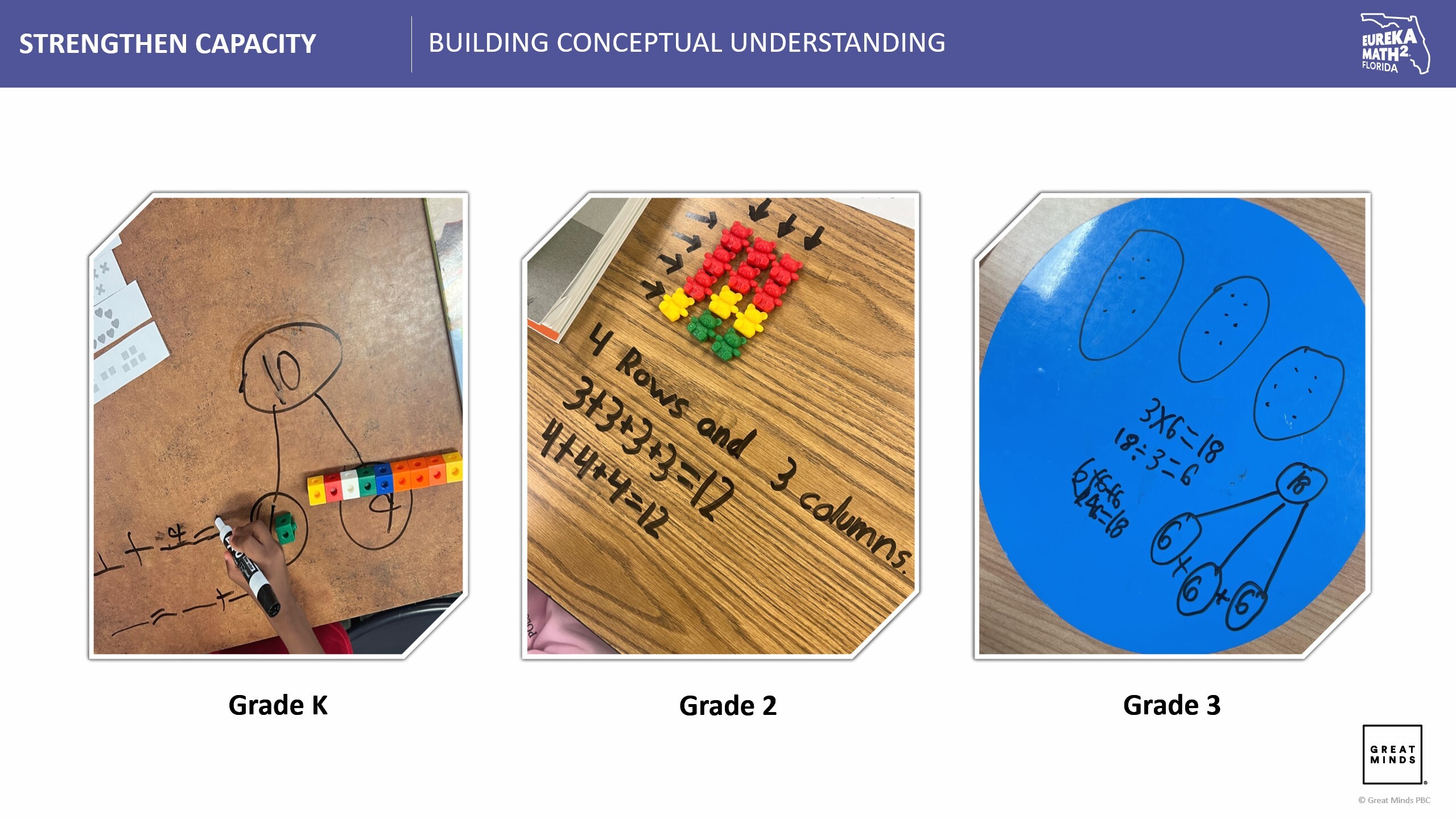
The learn phase is where new understanding is built. Students explore concepts through visual models, flexible strategies, and meaningful connections before formalizing their thinking. Rather than rushing to procedures, they engage with ideas, using representations like number lines to develop both conceptual understanding and procedural fluency.
Slide27

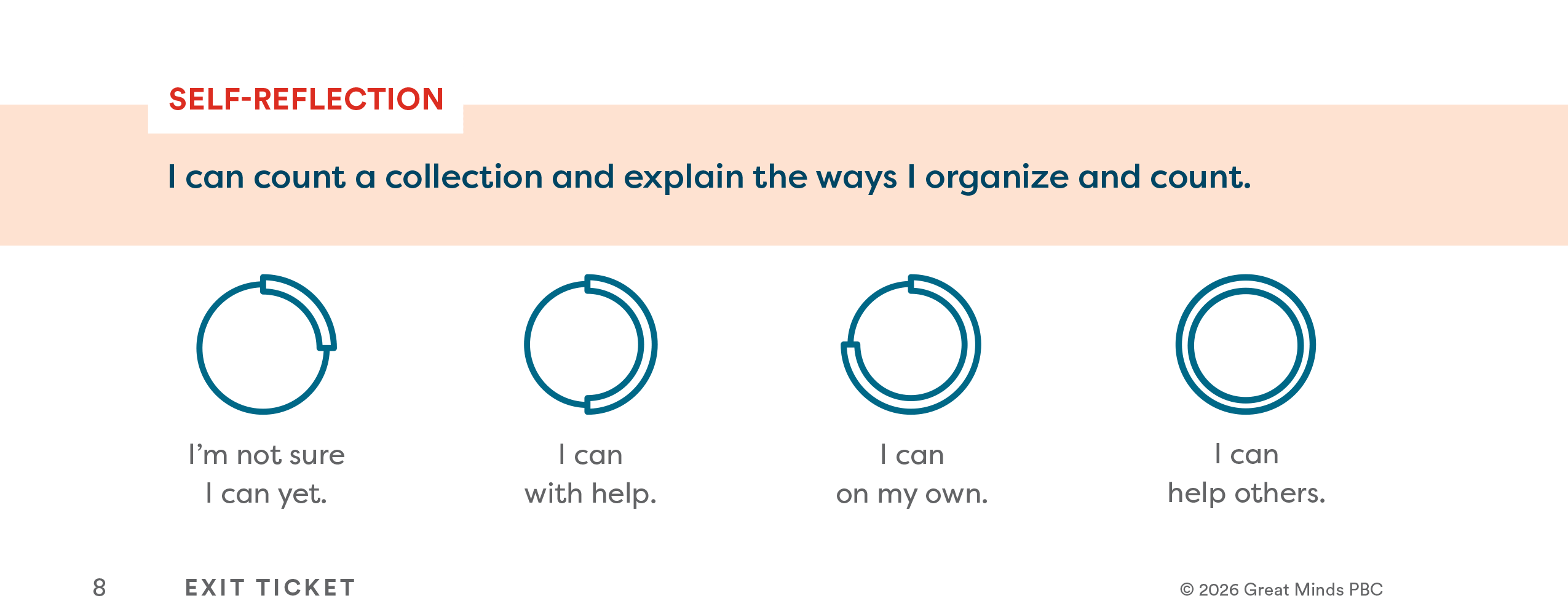
The land phase brings clarity and closure. Students consolidate their thinking, connect to clear learning goals, and reflect on their understanding. This helps make learning visible and supports students in taking ownership of their progress.
EM2FL_Self-Reflection-2


Together, these phases create a consistent instructional rhythm that ensures each lesson builds intentionally, supporting deep and connected mathematical understanding over time.

Scaffolded Instruction: Building Understanding Step by Step

Eureka Math² Florida carefully scaffolds learning so students can access grade-level mathematics with confidence. Students move from concrete and pictorial representations to more abstract thinking, supported by models such as number lines, diagrams, and visual representations.

Tasks are sequenced to gradually increase in complexity, allowing students to build understanding step by step rather than being expected to grasp abstract ideas immediately.

Explicit Instruction: Clarity Without Shortcuts

Explicit instruction in Eureka Math² Florida ensures that mathematical ideas are clear and purposeful. Learning targets are presented in student-friendly language, and lessons connect strategies directly to underlying concepts. Students are not rushed into procedures. Instead, they explore strategies like making 100 or compensation using visual models, ensuring that procedural fluency is grounded in understanding.

Inquiry-Based Learning: Productive Struggle Within Structure

Eureka Math² Florida creates space for inquiry within a structured system. Lessons often begin with engaging prompts, images, or experiences that invite students to notice, wonder, and ask questions.

Students explore multiple solution strategies, discuss their thinking, and apply their understanding to new problems. This approach encourages productive struggle while ensuring students are supported through intentional design.

Differentiated Instruction: Access for Every Learner

Differentiation is embedded throughout Eureka Math² Florida. Lessons provide multiple entry points through visual, contextual, and collaborative experiences so all students can engage with the mathematics. Students also have opportunities to reflect on their learning, helping teachers respond to their needs in real time and ensuring all learners can make progress.

Differentiation in Eureka Math² Florida is built directly into instruction at the point of teacher use. Teachers are equipped with clear guidance to both support students and extend their thinking. Problem sets are designed from simple to complex, ensuring every student has access to success while also providing opportunities to go deeper.

Why Balance Matters

Florida’s vision emphasizes balance across instructional approaches. Eureka Math² Florida delivers that balance with systematic instruction as the foundation, ensuring coherence and progression across lessons and grade levels. Scaffolding provides access, explicit instruction provides clarity, inquiry fosters engagement, and differentiation ensures every child experiences a joyful math experience.

Built for Florida, Designed for Impact

Eureka Math² Florida brings Florida’s Formula for Success to life through structured design, coherent progressions, and intentional integration of research-based instructional practices. Every lesson is designed to move learning forward, ensuring all students can develop deep and lasting mathematical understanding.

Dinsmoor, K. 2022. "Math Manipulatives." In S. L. Mason (Ed.), Student-Centered Approaches in K–12 and Higher Education. EdTech Books. https://edtechbooks.org/student_centered/math_manipulatives.

Gersten, R., Beckmann, S., Clarke, B., Foegen, A., Marsh, L., Star, J. R., and Witzel, B. 2009. "Assisting Students Struggling with Mathematics: Response to Intervention (RtI) for Elementary and Middle Schools (NCEE 2009-4060)." Washington, DC: National Center for Education Evaluation and Regional Assistance, Institute of Education Sciences, U.S. Department of Education. http://ies.ed.gov/ncee/wwc/publications/practiceguides/.

Hand2Mind. "Research on the Benefits of Manipulatives." Accessed February 21, 2023. https://www.hand2mind.com/media/contentmanager/content/Benefits_of_Manipulatives.pdf.

National Research Council. 2001. "Adding It Up: Helping Children Learn Mathematics." Washington, DC: The National Academies Press. https://doi.org/10.17226/9822.


Interested in seeing these concepts in B.E.S.T.-aligned math materials?

→ Request a free sample

Continue Your Review

→  Access Instructional Materials 
→ Explore the Digital Experience 


Want to Learn More?
See Our Related Content.

See how consistent classroom routines simplify instruction and strengthen student learning in Florida math classrooms.

→ Watch the Webinar


Discover how clear lesson structures help Florida students take an active role in math learning.

→ Read the Article