
A School Built to Find What Works
P.K. Yonge Developmental Research School isn't a typical elementary school. As a unit of the University of Florida and a school written into Florida statute with a mission to design, test, and disseminate best practices in education, P.K. Yonge is built to ask hard questions about teaching and learning and then answer them.
Located in Gainesville, Florida, P.K. Yonge's elementary division serves approximately 380 students.
"Our admissions are based on lottery, and our demographic mirrors the state of Florida," said Dicy Watson, Director of Elementary Programs. "Part of our mission is that no matter what student you are or what background you come from, we hold the belief that we're going to help you.”
That belief shapes everything at P.K. Yonge, including how it approaches math.
A Philosophy Build Around Collaboration and High Expectations
Walk into P.K. Yonge's elementary building and you'll notice something different right away. Many classrooms have no walls. Open spaces and glass windows connect learning communities, making collaboration visible and intentional.
The school organizes teachers into learning communities of six, sharing common planning time to push each other's thinking and align instruction. Each one is anchored by a learning community leader who is not a classroom teacher, but an interventionist and curriculum resource specialist who serves as, as Watson puts it, "the heartbeat of every learning community."
Guiding it all is the "Leader in Me" framework, built around core paradigms, including:
-
Everyone has genius
-
Everyone can be a leader
-
Empower students to lead their own learning
-
Families and students partner to develop the whole child
-
Change starts with me
"We have high expectations for all," Watson said. "And teachers really dig in on ‘What does success look like for this student? How are we going to get every student there?’"
This year, P.K. Yonge has focused schoolwide on student discourse and building students' ability to independently engage in mathematical conversations, challenge each other's thinking, and do the intellectual work themselves.
The Search for the Right Math Curriculum
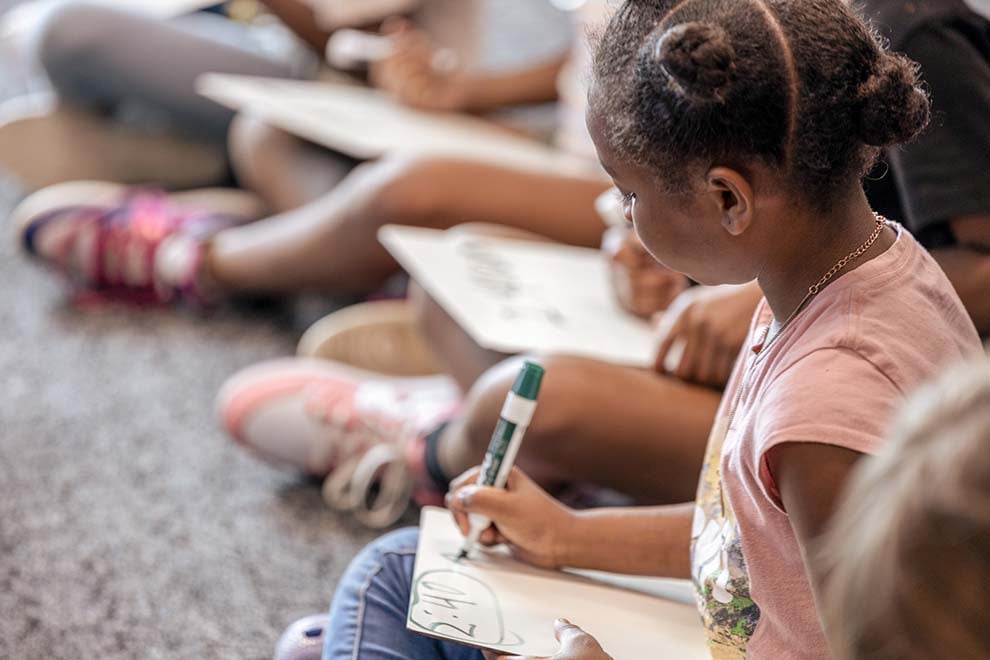
Before adopting Eureka Math² Florida B.E.S.T. Editon in the 2022-2023 school year for the school’s k-5 students, P.K. Yonge used a different curriculum — and the results were puzzling.
"Students felt engaged within the daily lesson, but it didn't feel like those skills were transferring in the way that we knew the students were capable of achieving," Watson said.
The leadership team knew what they needed: a curriculum with a predictable structure, significant opportunities for student practice, and a guarantee that every student — not just those who seemed ready — would have access to grade-level content.
"We wanted to make sure that every student had exposure to that rigorous core, because that's ultimately what they were all going to be faced with, whether on statewide assessments or in other areas of mathematics," Watson said.
After reviewing several programs, P.K. Yonge adopted Eureka Math² — and not just for the curriculum itself.
"We really liked Great Minds and the team behind it," Watson said. "That was a big part of it. We wanted to establish a collaborative relationship with people who would support us as we learned together."
Implementation: Meeting Teachers Where They Are
When Eureka Math² launched at P.K. Yonge, Great Minds supported the rollout with whole-staff onboarding and ongoing consultant visits throughout that first year, meeting with grade-level teams and the leadership team alike.
Watson emphasizes that implementation at P.K. Yonge has never been one-size-fits-all. Coaching is driven by what teachers and students truly need — delivered to the whole division, a single learning community, a grade level, or an individual teacher, depending on what the data shows.
New teachers are brought into the Eureka Math² philosophy primarily through their learning community, through team conversations, and the guidance of their learning community leader — often before they ever encounter a formal training session.
The advice Watson gives to any school starting with Eureka Math² is simple but essential: don't skip the "why."
"The implementation guidance and conversation around intention is really important," she said. "Once teachers understand the why behind how things are structured, they tend to trust the curriculum more and really buy in."
What Changed in the Classroom

The response from teachers when Eureka Math² launched was immediate — and overwhelmingly positive.
"It felt like we finally were seeing from our students what we knew they were capable of doing, on an independent level," Watson said. "We finally had the right tools — the right fit for our school, our students, and our needs."
Part of what made the difference was the curriculum's built-in progress monitoring and assessment tools. P.K. Yonge's previous curriculum lacked these, leaving teachers without a clear picture of where students were and what they needed. Eureka Math² filled that gap.
Watson also noticed a personal shift.
"I would try to give small-group students only math problems I felt they would be successful with," she said. "It's hard to see students struggle. But Eureka Math² shifted my thinking. Every student can do this. We know every student has genius. We just have to build that capacity for productive struggle, with the right care and support in place.”
Students who had used Eureka Math² throughout their whole elementary schooling were showing noticeably stronger number sense and place value understanding compared to cohorts that hadn't. The difference across groups has become a metric the team tracks closely.
Results That Speak for Themselves
P.K. Yonge's results with Eureka Math² have been significant. The school’s third-grade cohort in the 2024-2025 school year showed a 16% improvement year over year — a standout gain that reflects both the strength of the curriculum and the school's commitment to implementation.
By the final progress-monitoring period, nearly all students in tested grades met grade-level proficiency. Watson attributes this not just to the curriculum, but to the way Eureka Math² has changed how teachers think about their students — and what they believe those students can do.
"The results come from teachers who wholeheartedly believe in their students and in what's possible," Watson said. "And seeing those numbers confirms it."
A Research Partnership That Goes Deeper
Because P.K. Yonge is a developmental research school, its work with Eureka Math² goes beyond implementation. The school has formalized a research collaboration with Great Minds, led by a math affiliate faculty member jointly supported by P.K. Yonge and the University of Florida's Lastinger Center for Learning.
That work includes implementation walks, learning walks, and post-observation discussions — all structured to surface what teachers need, what leadership may not have realized was necessary, and how instructional decisions connect to student outcomes.
Learning walks at P.K. Yonge are a particular point of pride — and they look different than most.
"We might observe a teacher who has been struggling with the fluency portion of a lesson," Watson explained. "We go in together, engage in side-by-side conversations during the observation, and then debrief with questions like: ‘Why did you make that decision? How did your students respond? What did we notice?’ It's collaborative learning at every level."
Takeaways for Any School
P.K. Yonge is unusual — a lab school with a research mission, a lottery-based admissions process, and deep ties to a major research university. But Watson is quick to push back on the idea that its success is the result of exceptional circumstances.
"Sometimes we hear from other schools: 'This is really impossible for us because of our population,'" she said. "And I think that is a real challenge. But what we've found is that it always comes back to knowing your students and what they need — and holding the belief that you're going to get them there, no matter where they're starting from."
That belief, combined with a curriculum designed to make it real, is what's driving results at P.K. Yonge — and what its leaders hope to spread far beyond Gainesville.